
By Farmer Becca, Bottomland Farm —
My great-aunt was a biology teacher and an environmental educator. She loved teaching, but I think she loved learning even more. I imagine that’s why she also had a keen interest in history. When I was young, she had bookshelves stacked with large three ring binders that were full of old tintype pictures, scribbled out family trees, deeds, and other historic documents. Much of my time with her was spent listening to family stories, many of which were rooted in place. The land was a character in these family stories just as much as the people were.
I was reminded of my great-aunt a few weeks ago when I found myself paging through the old deed books at the county clerk’s office. About a month ago, we found out that Tioga IDA had been awarded funding to conduct a study to determine if a public trail could be placed right next to the active rail line that runs along the rail corridor through the center of our farm. For a lot of reasons, this could create some serious challenges for the future of our farm.
And so, upon learning this news, I immediately got to work and started to research. It wasn’t necessarily research I had wanted to do, or that I had planned on doing this winter, but it has only added depth and connection to this ground I farm on.
It didn’t take me long to learn that the South Central Railroad bought up much of the railroad right-of-way about 160 years ago, in the late 1860s and early 1870s. While I was sifting through deeds and old maps, I couldn’t help but wonder about the names listed on the documents, these people who were long gone. Where did they come from? Did they farm? Did they love this place as much as we do? Did they think about the people who might be farming here 150 years after them?
One night, when I couldn’t sleep from worrying, I did a bit of research on Samuel A. Blair (the 1865 resident of the original farmhouse). Not only did I find the population census for 1865, but I also stumbled across the agricultural statistics as well. I’ve often found myself wondering what this place was like 150 years ago: what family stories were left here? Was our maple grove their maple grove? Did they make hay in the same fields we graze?
But now, through agricultural statistics, I can piece together the broad genealogy of our farm. In 1865, Mr. Blair raised two pigs to butcher for 406 lbs of pork; he raised six lambs; owned $4.50 in poultry; had 10 apple trees that produced 10 bushels of fruit; milked three cows producing 450 lbs of butter; made 300 lbs of maple sugar and six gallons of maple syrup.
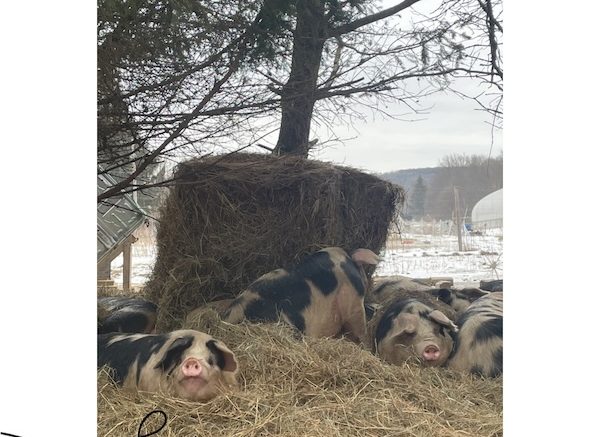
I’m sure, if Mr. Blair could see our town and our farm today, it would be somewhat unrecognizable, but then again, maybe not that much has changed. We still have pigs, we still have chickens, we still have our maple grove, and we have 10 apple trees (which have yet to produce a bushel each, but we’re waiting patiently).
Now, as I go through my farm day, Mr. Blair and the decisions he made in 1865, will be riding in the back of my mind, providing me with a little more insight and connection to the landscape we borrow from future generations.
(Bottomland Farm, located in Berkshire, N.Y., can be contacted via email at farmer@bottomlandfarm.com.)

Be the first to comment on "A Farmer’s Thoughts"