
[By Wendy Post]
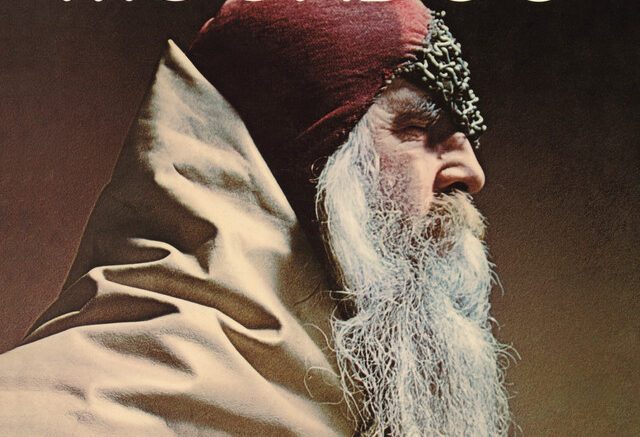
Upon moving to Owego in the 1980s, I heard stories of a man named “Moondog,” or the “Viking of 6th Avenue.” His real name was Louis Thomas Hardin (1916-1999). This story caught my attention, as did the mystery surrounding Devil’s Elbow, but we can save that story for Halloween.
Back to Moondog. I was told stories of a Nordic man, who dressed like a Viking. He was a brilliant composer who sold his music and was referred to as “genius” in the music industry. In fact, one of Moondog’s songs, “All is Loneliness,” was recorded twice by music icon Janis Joplin.
But here was the part of Moondog’s story’s entirety that not only amazed, but also created a picture of brilliance and resilience: Moondog was blind.
Stories told that Moondog could often be seen in front of the Smoke Shop on North Avenue in Owego, as he would take a bus back and forth to New York City, where he could be found between 6th Avenue between 52nd and 55th Streets, wearing a Viking helmet along with his homemade attire. The timeframe was prior to 1974, and his eventual return to Germany.
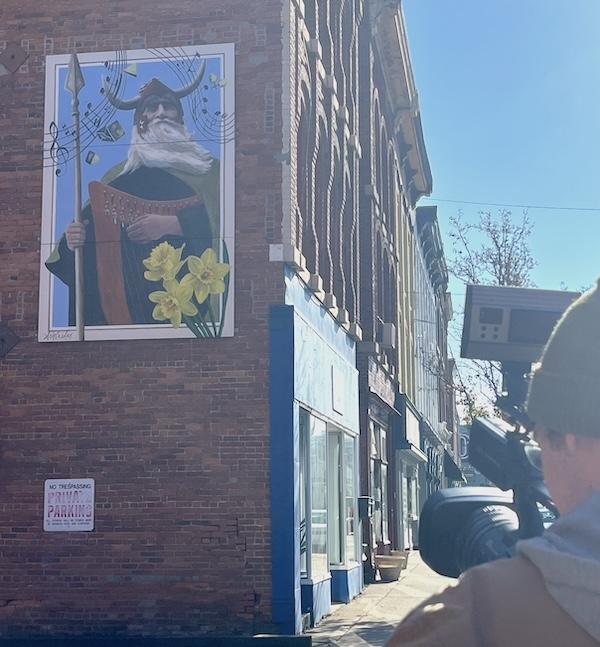
Pictured is “An Homage to Moondog,” a newly installed mural located near the North Avenue bus stop in Owego, where the Viking was often spotted. (File photo / Sebby S. Truesdail)
“I’m fine! I’m really better than fine. This is another little adventure we are on.” — Moondog
Now, years later, and near that same location, there is a mural; a towering image of Moondog. Installed through the Tioga Arts Council (TAC), and with Michelle Schleider, Mural Artist, and its project partners, An Homage to Moondog now faces the alley and the parking lot located at 72 North Ave. In Owego. The artistic tribute is visible to all who pass by, to see; undoubtedly leaving them with a bit of wonderment, with questions surrounding the Viking.
There were many stories at that time, many coming from a man named Michael Gulachok – a man with a close connection to Moondog. Other stories tell of how Moondog built a place to hang his hat, somewhere out in the woods in Candor, N.Y. At that time, people retold stories of Moondog moving his own logs and navigating the land.
In early 2017, several dozen residents gathered in Candor with photos and newspaper clippings in hand to discuss and remember the life of the legendary musician with Candor’s Historical Society. To tell a broader story of the Viking’s life and the mark he left on the region, the following told the story, as delivered at the 2017 meeting, and in a story previously published at that time in The Owego Pennysaver Press.
“Gotta go low to get high.” — Moondog
Moondog lived in Candor for a number of years and spent time in the Village of Owego, yet was best remembered as a New York City original, coined the “Viking of 6th Avenue.” Extremely proud of his Nordic heritage and interested in mythology, Moondog was often found on 6th Avenue between 52nd and 55th Streets.
One of the most incredible facts about Moondog was that he was blind, since the age of 16. So his travels, and the composure of his music, is a fact that adds utter brilliance to his mystique.
Plug the word “Moondog” in the search field of a historical newspaper website, and hundreds of matches are returned with publication dates going back to the late 1940’s.
From the “blind trouba-doorway minstrel” to “Upstate’s blind Viking-poet composer,” and then, “the blind curbatone Mozart,” to the “Mid-town Manhattan guru,” Moondog became a favorite topic of the press, and most often fondly described.
Interesting, a New York Times article states that when asked by pedestrians on the street where he was from, Moondog would reply, “Sasnak” (which is Kansas, backwards).
Born in Kansas in 1916, and raised in Missouri and other Midwest states, it was an accident at the age of 16 while playing with blasting caps that took Hardin’s eyesight. He went on to learn Braille while attending several music schools. Hardin passed away in Munster, Germany, in 1999 at the age of 83, and a book about his life describes him as “one of America’s great originals,” and “the most famous eccentric in New York.”
The name he identified with, Moondog, was derived from listening to a dog he had as a child that howled at the moon with him.
Attendees at the Candor Historical Society event at that time shared that Moondog was a “gentle man, empathetic, and a decent guy.”
Although initial perception may have labeled Hardin negatively, the word “genius” tends to best describe the man who was ultimately seen as a prominent talent in music history and who influenced many composers and musicians.
“My only baggage is my spiritual purpose. I take my spirit with me. We are all beings of the soul. We all live under the same sun.” — Moondog
Following several years in New York City, by the late 1950’s Hardin was looking to get out of the city and ended up choosing Candor, with the intention of commuting back and forth. It is thought that the rural area of Candor appealed to Hardin since it is similar to the areas where he grew up.
Event attendees at the early 2017 event described Moondog’s property as several acres and the home as a two-room shack with a roof covered in green tarpaper, where you had to duck your head to make it through the front door.
They shared that Moondog would often be found in front of the Smoke Shop on North Avenue in Owego, perhaps because that was where the bus stop was located, and where he would stand and recite poetry.
Known for his masterful orchestral suites and madrigals, as well as incorporating and mixing street noises and other clever sounds into his compositions, Moondog also made money in his early days selling radio jingles and tunes for television commercials. From Carnegie Hall to the Tonight Show with Johnny Carson, Moondog became well known in the entertainment world, and even to such notables as Leonard Bernstein, Arthur Toscanini, and Benny Goodman.
Perhaps one of the most publicized stories about Moondog occurred in 1954 when he won a New York State Supreme Court case against famous Cleveland disc jockey and later Rock and Roll Hall of Fame inductee Alan Freed, who had used the name “Moondog” for his on-air show as well as the titles of Moodog’s recordings. The case identifies Goodman and Toscanini as testifying on Hardin’s behalf.
“I am quite certain that the world is conspirin’ to make me happy.” — Moondog
Moondog traveled to Germany in 1974 and ended up staying. “World-renowned” was used to describe his time there, and where he toured throughout Europe. Following several albums in the States and Europe, Moondog’s last known visit to the U.S. was in 1989 when he conducted the Brooklyn Philharmonic Chamber Orchestra.
Moondog’s musical talent also included his instrument inventions, one of which was a triangular-shaped harp known as the “oo,” and another, a percussion instrument called the “trimba,” just two of many that he left behind as part of the legacy to his genius.
A full-length documentary about Moondog’s incredible life can be found on several streaming platforms, or you can visit https://www.thevikingof6thavenue.com.

Why aren’t there any photos of moondog from either New York City or Owego. Cameras were invented in the 1800’s so surely someone must have a still photo of him. I’d like to see him as he was.
I have a color photo of louis hardin’s home circa ’71 on slate road candor. I am developing color reproductions which I will share soon.
Can’t wait!