
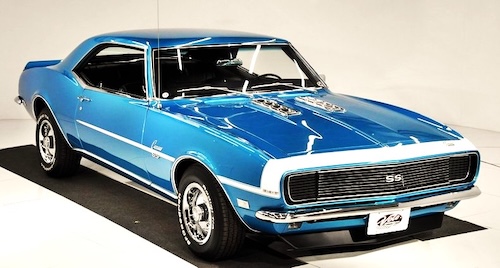
— Readers ask about my favorite ‘big‑block’ Chevrolets —
[By Greg Zyla]
Over the years, many readers have asked me which “big‑block” Chevrolet was my personal favorite. Truth be told, there have been many. To help answer that question, I’ll start with a conversation from 2023, when I received a letter — followed by a phone call — from Gary Latta of Vestal, N.Y.
Gary told me about his incredible 1970 Chevelle SS powered by the legendary 454 LS6. He’s owned the car for 43 years, and I’m hoping to visit him this summer to finally see it in person.
Gary admitted that much of the joy of these cars isn’t just driving them but working on them yourself — right in your own garage. That’s something today’s computerized vehicles have largely taken away. Open the hood of a modern car and, half the time, you can’t even see the engine.
Naturally, our conversation turned to Chevrolet big‑block engines, especially the high‑performance versions. I ended our call by telling Gary how fortunate he was to own one of the most desirable muscle cars of all time.
Even here in 2026, I still believe 1970 was the greatest year for muscle cars. We didn’t know it at the time, but looming just ahead were unleaded fuel, emissions mandates, and horsepower‑robbing smog equipment. By 1974, the Hemi ’Cudas, 440 Six Packs, 455 Buicks, fast GTOs, solid‑lifter Chevy big‑blocks, and the mighty 428 Cobra Jet Mustangs were all gone.
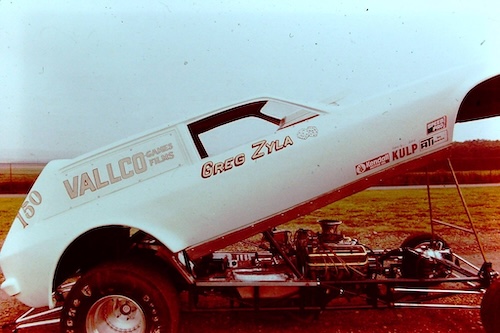
Our author’s Chevrolet 454 LS7 was available as a crate motor offering and labeled “for off-road use” only in 1979. It is shown here between the chassis rails of his Vega Panel Wagon funny car. (Zyla collection)
My favorite big‑block of all
My personal favorite was my 1968 Camaro SS/RS, equipped with the L78‑code 396/375‑horsepower big‑block.
Thanks to my mother co‑signing the loan, I bought the Camaro used from a Ford dealership in Vineland, N.J. It sat atop a rotating display with “$2,995” written in shoe polish across the windshield. What caught my eye immediately were the “396” fender badges. I knew right then it had the engine I wanted.
When the salesman stopped the turntable and opened the hood, my decision was made. I bought the car “straight sale” — no trade‑in. Maybe I could have saved a few hundred dollars, but that L78 engine, with just 12,000 miles on it, was staring me in the face. The 375‑horsepower decal on the air cleaner sealed the deal. Even better, it was an SS/RS, the top Camaro option that year.
What mattered most to me was that the L78 was essentially the same engine offered in the 1965 Corvette, where it was rated at 425 horsepower. Interestingly, 1965 was the only year a Corvette ever came with a 396, although plenty of 427s — and later some lower‑compression 454s — would follow.
Like the LS6, the L78 used solid‑lifter, flat‑tappet camshafts, which meant two things: more aggressive cam lift and the need for frequent valve‑lash adjustments. For me, checking valves became a weekly ritual.
The perfect setup
I had just returned home from Army National Guard active duty at Fort Jackson, S.C., and following my purchase, there sat my dream muscle car in the driveway. Everything about it was exactly right: a Muncie M22 “rock crusher” four‑speed, a 12‑bolt rear, and 4.10 gears.
The first upgrade came soon after. I ordered a set of Hedman headers from the Sears & Roebuck store where I had just landed a job in the paint department. My first Sears credit card wasn’t plastic — it was cardboard — with a $400 limit. The headers cost about $120.
When they arrived, my friend Bernie Cardia installed them at his new garage. I swear they added 20 horsepower — maybe more. Believe it or not, I still have those headers today, and they’re in excellent condition.
The Camaro became well‑known around town and even more so when I took it to college in Emmitsburg, Md., in 1971. After seeing what the car could do, most people didn’t want to race me — except for two.
Both races were for $50, serious money in 1971. One was against a spotless Z/28 Camaro, backed by a friend who owned a 428 Cobra Jet Cougar. His father, I later learned, was part‑owner of the Baltimore Colts.
After I beat the Z/28, the Cougar owner put up another $50 and called me out. According to a friend near the finish line, there was a “tractor‑trailer” ‑length gap between my L78 Camaro and the Cobra Jet. That ended any further discussions.
A memorable encounter
There was a third “race” of sorts — though it wasn’t intentional.
One cool fall evening on Route 15 near Hagerstown, Md., a car pulled up tight on my bumper after I left a gas station. Still in first gear, I gave it a quick run, speed‑shifting the M22 and pulling away — but not by much.
That’s because the car behind me was a Ford police cruiser. The lights came on just as I hit fourth gear.
Fortunately, the officer was a car guy. Instead of a ticket, he wanted to talk Camaros. He had just taken delivery of his 1971 cruiser with a 429 Police Interceptor, and I gladly popped the hood to show him my L78. We parted as friends — and I drove away very relieved.
One more big‑block memory
My next big‑block came in early 1979, when I ordered a 454 LS7 crate engine from Campbell Chevrolet in Shamokin, Pa. The price? $1,480, with “For Off‑Road Use Only” decals on the valve covers.
That engine went into my 1972 Vega econo‑funny car. After a rebuild by drag‑racing legend Jack Kulp, it ran 9.65 seconds at 135 mph, using nothing more than an Isky flat‑tappet cam and an 800‑cfm Holley double‑pumper.
The car used an ATI Turbo 400, ATI converter, 4.88 gears, and a bulletproof 1957 Pontiac‑Olds rear.
Last thoughts
The L78, LS6, and LS7 big‑block Chevrolets remain among the most respected and powerful muscle‑car engines ever built. Their legacy lives on — not just in numbers, but in memories.
Next week: a less technical look at Pontiac GTO history and my favorite year. Stay tuned.
Author’s note: I do not condone or support street racing — then or now. I lost my best friend in a street‑racing accident. It is extremely dangerous.
(Greg Zyla is a syndicated automotive columnist who welcomes reader input on classic cars, auto nostalgia, or motorsports at extramile_2000@yahoo.com or Greg Zyla, Roosevelt Street, Sayre, Pa. 18840.)

Be the first to comment on "Collector Car Corner/Cars We Remember"