
Q: Hi Greg, I enjoy your columns in the Westerly newspaper and on the Internet, and in Auto Roundup magazine. I’m really enjoying your Top 10 Muscle Car series; so my question is simple, maybe stupid. What is your definition of a muscle car?
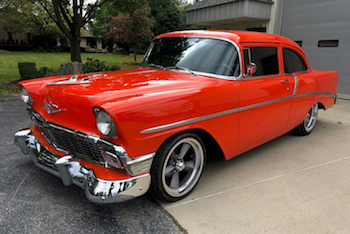
Most auto writers frequently mention muscle cars originating in the 1960s. What about the ‘50s? I saved a copy of a column you wrote back in Auto Roundup back in 2011 from a reader in Coldwater, Michigan who purchased a brand new 1956 Chevrolet “210.” He said the dealer’s salesman showed him an index card that listed the cars identification and options. The first thing he saw on the card was an optional “8-barrel carburetor.”
The person bought it quickly and found that “8-barrel carburetor” was really two four-barrels, and that was just the start of muscle options. There was an aluminum intake manifold, 9.25 to 1 compression pistons, oversize intake valves, dual springs on all valves, solid lifter cams, exhaust collectors, dual point distributor, heavy duty clutch, coil springs, close ratio transmission and dual exhaust.
The guy who wrote the letter, Jack Collins from Coldwater, Michigan, further said that Chevy’s speedometer only went to 110, and he could bury the needle in second gear and never used third gear at the drag races. He then said the only thing keeping this car from being a muscle car was its 265-inch displacement V8. He then recalled other cars of the era including the 1957 Plymouth Fury with two four-barrels and a reworked engine that was very fast.
So, what’s muscle and can you touch on today’s tribute and clone cars? It can get confusing. David Jones — Retired in Rhode Island.
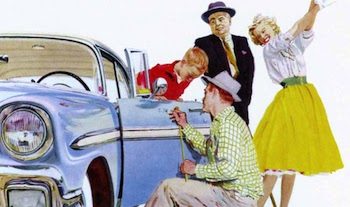
Advertisements back in 1956 found many artists under contract to do paintings. Shown is a Norman Rockwell style ad for the ’56 Chevy, and we can confirm Rockwell did advertisement paintings for Chevrolet, Plymouth, Ford, and Studebaker. Personally, I’d say we’re looking at a Rockwell work of art in this example. (Chevrolet)
A: David, thanks for your question and kind remarks. In my opinion, a muscle car is any American produced vehicle with a high horsepower engine that was knowingly built for performance. The muscle cars from the 1960s were usually intermediates and pony cars, but we can’t forget examples like the larger 409 Chevy Impalas, 427 Ford Galaxies, and 426 Plymouth Belvederes.
The 1956 Chevy 210 you recall was without a doubt a true muscle car, and the smaller displacement engine doesn’t have anything to do with the definition, again in my opinion. I feel a good example was the Camaro Z28 I chose in my Top 10 a few weeks ago that arrived in 1968 with a 302 small block under the hood.
Other “smaller V8” cars from the “muscle car” period include the Boss 302 Mustang, all those great 340 MOPARS, and on and on. Of course, the popular muscle cars like the 426 Hemi Roadrunner, 454 Chevelle, 428 Cobra Jet, 440 Six-Pack Challenger, 455 Buick, SD 455 GTO, and even the 390 AMC Scrambler receive most of the ink from that era.
Still, the years 1956-1957 were loaded with fine examples of Detroit muscle. Chrysler had the Plymouth Fury 318 dual quad version you mention, and Ford served up a special “E code” Ford Sedan with a 312 V8 and two four-barrels. And there was also a hot one from Rambler, as the Rebel 327 with a single four-barrel could out accelerate many of the hotter cars from the era. Problem is, this Rambler was never built for standalone performance as it just fell into it unknowingly.
If we look back further, Oldsmobile and Cadillac both offered the first post war overhead valve V8 engines as the ‘49 Olds Rocket 88 is considered by many of us “baby boomer” auto writers as the first true “muscle car” ever produced (again not intentionally).
Notables are the really big engines, which back in the day were all different from each other. There are those who still think the 455-V8s from Buick, Pontiac and Olds were all basically the same. That is not true, as each was different and nothing of importance exchanged. These engines started to appear in 1968, and my favorite of the three is the 1970 Buick 455 Stage One, which featured the largest bore and shortest crank throw of the three. Notable is I selected the 1970 Buick GSX in my Top 10 just four weeks ago.
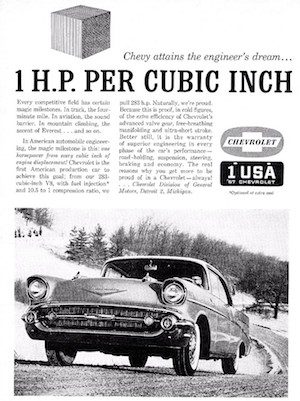
Chevrolet was 100% behind in finding performance at any cost. By 1957, Chevrolet was pointing toward its one horsepower per cubic inch achievement with the 283-horse fuel injected 283 V8. (Chevrolet)
Now, on to the tribute and clone question, and I’ll throw in “fake” to the discussion when it comes to non-numbers matching muscle cars. Car collectors have used all three of these terms, but clone is now not as popular in the collector dictionary and many times replaced by tribute. The word “fake” was the most unpopular for a non-number matching car, and used mostly when an owner was trying to pass off his/her car as “original numbers matching” when most of the educated collectors knew better. Through the years, many unscrupulous sellers sold so-called “numbers matching” vehicles to unaware buyers to the dismay of the new owner. However, now that the hobby has evolved and everyone seems more educated, the “fakes” are now easily uncovered, mostly after a consumer purchase.
To explain what a tribute is, I have a 1972 Dodge Challenger R/T “tribute,” powered by a high performance 440 (plus .40) 1969 TNT engine that came out of a 1969 Chrysler. Considering the big-block engine was not available in 1972 in the Challenger line, nor was an R/T model, most everyone I run into knows this is a “tribute” car. So, let’s just say a tribute can be any car that is not original and does not have correct year parts.
In my opinion (which I again stress), this is where a clone is different from a tribute. In my dictionary, a “clone” is a car that is correctly representative of the year it was produced but does not have the original engine / transmission and a few other ancillary parts. So, if someone has a 1967 Dodge Coronet and then puts a 426 Hemi engine in it, adds R/T badges, hood and rear treatment, exhausts, etc. with a 4-speed and Dana 60 rear or a Torqueflite with an 8 3/4 rear, then this would be a nice R/T clone because you could go into a dealer back in 1967 and order one just like it. So, I’m still a fan of the word “clone” because it represents a car that was available in whatever year and sits with the same mechanicals as a number matching R/T.
Now, I mention the vehicle Identification Number (VIN) plate because this is also very important. When you see what looks like a totally junk car being sold for $15,000, it’s because the VIN designates it as a real, rare muscle car unlike the above-mentioned 1967 Dodge R/T Hemi clone example. Whoever buys it can put it back together in its original form, with a replacement Hemi engine from 1967 and a correct transmission that relates to 1967. When finished, the new owner can advertise the car as a real ’67 R/T with correct VIN and use of 1967 parts. The seller explains to the new owner it is a correct year engine but not the one that originally came in the car. So, can you call it numbers matching? Some say yes, others no, but the car is worth quite a bit more on the market regardless thanks to the VIN. (Popular now is the word “correct” regarding engine / transmission).
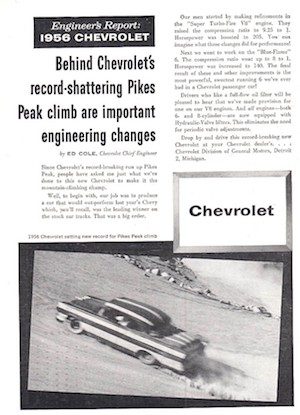
In 1956, Chevy won its class at the annual Pike Peak Hill Climb, the first of many hill climb victories. The driver? How about Zora Arkus-Duntov, known as Godfather of the Corvette and a top Chevrolet engineer. (Chevrolet)
I know this is all a bit confusing, but the hobby pretty much identifies and investigate cars that fall into these categories with proper money values attached to fake, tribute, clone, correct and numbers matching efforts. To assist, there are many professional appraisers that can tell you quickly (for a fee) exactly what you are looking at. To me, an original numbers matching car is the ultimate, but right now I’m happy to own a ’72 Challenger R/T tribute. Remember, too, that clones are also used by many pros as the same nomenclature as tribute, but I disagree. My ’72 Challenger is in no way original, that’s why I call it a tribute, not a clone. I basically built the car to be what I feel a ’72 Challenger R/T would have been like.
In ending, be it tribute, numbers matching or clone, the hobby is so much fun nowadays regardless of proper names. I expect it to be even stronger as the years go by. Thanks again for your question, and for following my 10 Top Muscle Cars of All-Time series.
(Greg Zyla is a syndicated auto columnist who welcomes questions on collector cars, motorsports and auto nostalgia at greg@gregzyla.com or at Greg Zyla, Roosevelt St., Sayre, Pa. 18840.)

Be the first to comment on "Car Collector Corner; 1956 Chevy 210, Muscle Car, Tribute and Clone further defined"