
Studebaker Avanti and Andy Granatelli
Q: Greg, how was Indy 500 and STP legend Andy Granatelli involved with the Studebaker Hawks, especially the supercharged Golden Hawks of the 1950’s? I remember when he won the Indy 500 with Mario Andretti, but not too much of his Studebaker roots. Thanks, and keep your old car columns coming they are very interesting. Like Forrest Gump said in the movie, “You never know what you’re gonna’ get.” Larry M., retired and happy in Lancaster, Pa.
A: Larry, thanks much for your comments and it’s true, you never know what’s coming thanks to readers like you.
The late, great, Andy Granatelli, who passed away in 2013, was the “head honcho” at Studebaker Racing in the early 1960s. His Studebaker involvement started when he initially got involved with the McCulloch Supercharger Company that supplied superchargers in 1957 and 1958 to Studebaker for those magnificent Studebaker Golden Hawks.
Over the following years, Granatelli became involved with the 1962-63 Studebaker Gran Turismo Hawk and Studebaker Avanti, both equipped with Paxton Superchargers as standard equipment. Even more important is the fact that Granatelli designed the supercharged engine under the hood of those Gran Turismo beauties, quite an accomplishment.
Also needing further explanation is the McCullough and Paxton supercharger connection. These supercharger companies were pretty much one and the same corporately and the brainchild of Robert Paxton McCulloch. (See the connection?) McCulloch established a separate Paxton Supercharger division in 1956 and then sold it off in 1958. Granatelli, meanwhile, was fully involved in this supercharger merger / connection and always had racing as his main goal.
As for the beautiful 1957 and 1958 Studebaker Golden Hawks, they are some of my favorite cars from the Fifties. Both came with McCullough superchargers on 289-inch V8 engines that are not related to Ford’s 289 in any manner. Then in 1962, Studebaker purchased all of the Paxton Supercharger business at a time when Granatelli was president of Paxton and head of Studebaker’s Racing Division. Granatelli became more and more involved with the supercharged Hawk and Avanti, the latter that he drove to speed records at Utah’s Bonneville’s Salt Flats.
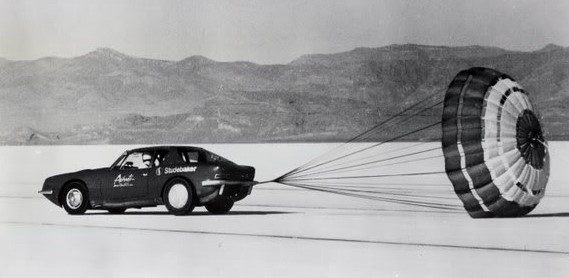
Andy Granatelli pops the parachute on his Avanti after a run of 196-mph at Bonneville in 1963. (Mobil promotional photo)
Specifically, Granatelli, with his engine firing on all eight cylinders and the Paxton supercharger adding more power, drove his 1963 Studebaker Avanti to a time of 196.58 mph at Bonneville. Previously, he had run 170.78 mph in 1962 and proclaimed Avanti the world’s fastest street car.
This, in a nutshell, is the connection of the auto racing legend Granatelli to Studebaker and the superchargers, although Granatelli would go on to greater fame with his STP Indy Cars and his Richard Petty long-term STP sponsorship. Granatelli was the CEO of the STP Corporation, an oil additive he developed back in 1964 and an instant hit thanks to Granatelli’s marketing savvy.
Notable is Granatelli’s unique, yet heartbreaking, Indy 500 efforts. Twice he brought turbine-powered cars to Indianapolis (1967 and 1968) only to see victory snatched away both years with the checkered flag in sight. Parnelli Jones had the race won in ’67 when a $6.00 part broke with three laps to go while leading and then in ‘68, Joe Leonard broke with 10 laps to go while leading.
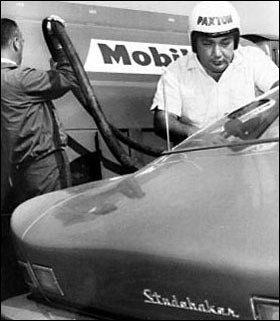
Andy Granatelli fuels up his supercharged Avanti with Mobil gasoline before making a run at Bonneville. Check that crash helmet! (Mobil promotional photo)
Thankfully, the gods of racing awarded Granatelli as he did experience victory at Indianapolis in 1969. Most fans should recall Mario Andretti receiving a victory lane kiss from Granatelli after his winning drive. Granatelli, known as “Mr. 500,” won again in 1973 with Gordon Johncock, all of which is covered in detail in Granatelli’s book, “They Call Me Mr. 500.” I found a used copy on Amazon and it’s indeed a great read and highly recommended.
Unfortunately, Studebaker exited the car business in the U.S. in December of 1963, although Canadian Studebakers were built through model year 1966. Avanti, meanwhile, sold its tooling and the Avanti brand name, along with U.S. plant space, to South Bend, Indiana, Studebaker dealers Nate Altman and Leo Newman. They re-introduced hand-built versions of the original using leftover Studebaker chassis parts with engines purchased from General Motors. A few other investors got involved, producing the Avanti II and other versions until 2006.
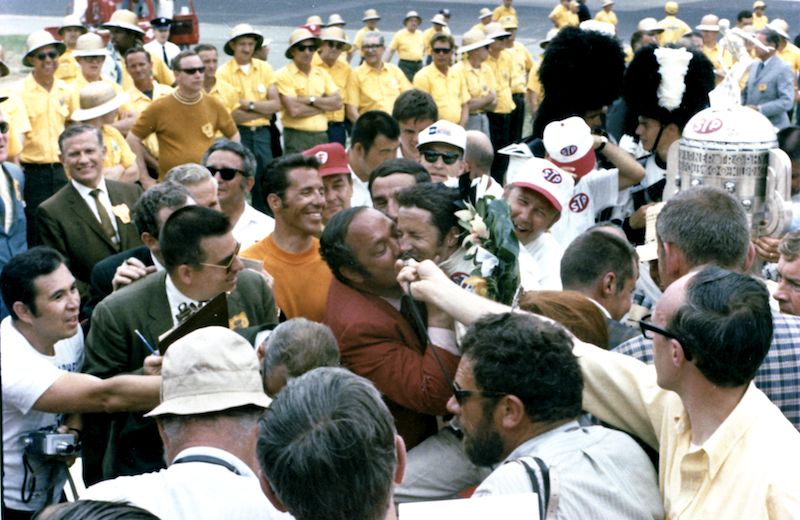
Granatelli kissing Mario Andretti after victory at the 1969 Indy 500
Paxton, meanwhile, still sells superchargers in a co-op with Vortech Superchargers for a variety of muscle cars, especially V8 Mustangs and Camaros. Thanks for the question Larry and I love the Lancaster area where I took my family regularly to Dutch Wonderland and the many Amish attractions and eateries nearby.
First independent overhead valve V8? It’s Studebaker again
Q: Hello Greg and thanks for all your nostalgia columns. My friends are discussing the V8 engines that appeared post World War II. Who built the first overhead valve V8 engine other than GM, Ford or Chrysler? Thanks, Jim K., Danville, Pa.
A: Jim, first I’ll list the independent manufacturers that were around post World War II. Included, in alphabetical order, are Crosley, Frazer, Henry J (same as Sears Allstate), Hudson, Kaiser, Nash, Packard, Rambler, Studebaker and Willys.
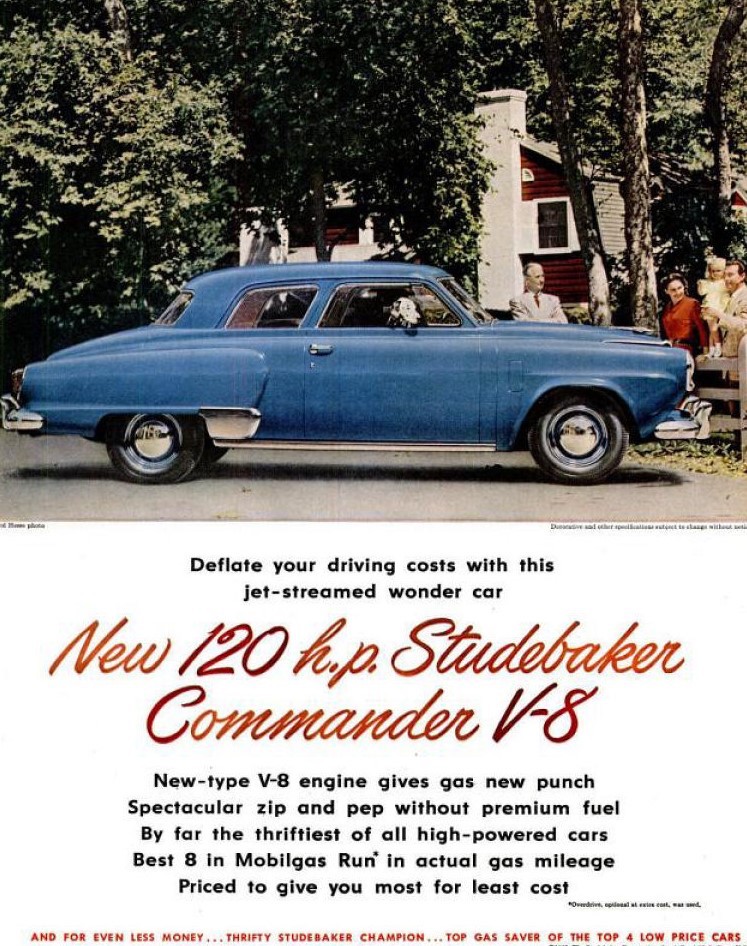
Studebaker for 1951 ushered in the first ever independent manufacturer overhead valve V8, which came standard in the Commander line. (Former Studebaker)
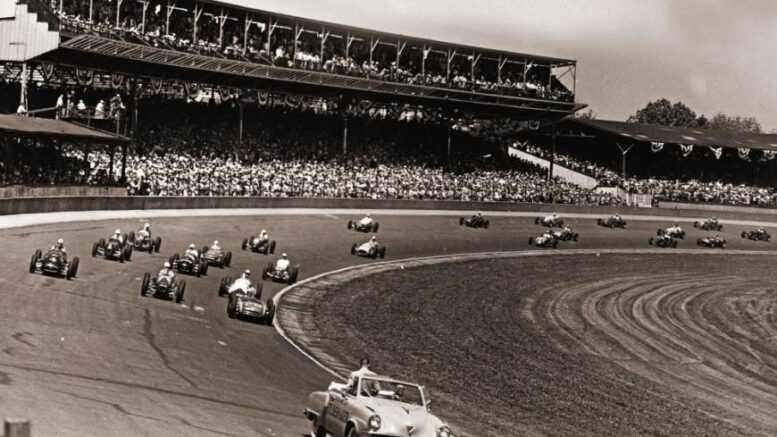
Of this group, and clearly pertinent to this week’s subjects, it was Studebaker that designed and built the first, non “Big Three,” overhead valve (not flathead or inline) V8 thanks to its 1951 232.6-inch, 120-horsepower V8. This engine was standard in the top class Commander, while the Champion models still relied on Studebaker’s 169.6 cu. in. 85-horsepower inline six. Notable is that in 1952, a Studebaker Commander Convertible V8 was named the official pace car of the Indianapolis 500 and looked mighty fine pacing that field.
I remember the bullet nose Studebakers from my youth, which appeared in 1950. I also recall the wraparound rear window on the Starlight coupes from 1947 to 1952. These Starlights had very wide B pillars, but were unique in appearance and to this day are big attention getters at car shows.
As for American overhead valve V8 engines overall, Cadillac had a 330-inch V8 way back in 1914, and Olds followed in 1916 with a 244-inch V8. Several others appeared, even Chevrolet in 1917 with a 288-inch V8 prior to merging with General Motors in 1918. The next Chevy V8 would appear in 1955, the most famous of all that debuted in 265-inch size.
In closing, Studebaker was a strong independent brand, but lost its consumer appeal following a failed merger with Packard, then a luxury brand that also had strong consumer appeal. The merger turned out to be a financial nightmare mostly due to Studebaker’s marketing miscues and financial woes.
Thanks for your question Jim, and I’d say Studebaker got its just due this week.
(Greg Zyla is a syndicated auto writer who welcomes reader questions and comments on auto nostalgia, collector cars, and old time motorsports at greg@gregzyla.com or USPS mail at 303 Roosevelt St., Sayre, Pa. 18840.)

Be the first to comment on "Cars We Remember / Collector Car; Studebaker, Studebaker and more Studebaker"