
[By Stephen Grant Beukema]
When you think of the most well-known military figures from Owego, New York, whom do you recall? Is it Medal of Honor winner and ‘Father of the Modern Navy,’ General Benjamin Franklin Tracy? Or maybe his brother-in-law and fellow Medal of Honor winner, General Isaac Catlin?
What about Generals Daniel McCallum, Henry Martyn Robert, or Osmond Leahy?
Or could it be another Medal of Honor winner, Richard Stout, or Astronaut Doug Hurley?
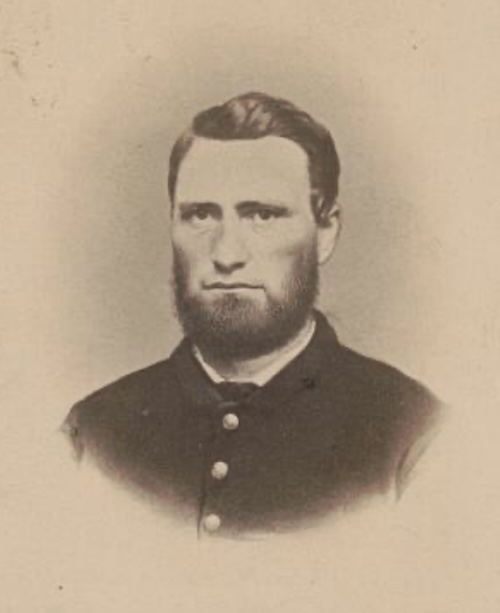
Pictured is Amos Humiston. Library of Congress Photo.
Some of you might now be actively manipulating your smart devices to determine who some of these people are. By the way, if you would like a shortcut to all of the aforementioned names go to “Owego (village), New York” On Wikipedia and then to the drop-down box “Notable people.” The author has compiled that list.
Now, about the person who is the basis for this article. This man is none other than the mystery man of the ‘Battle of the Brickyard’ in Gettysburg. A Union soldier found dead clutching a picture of three children. A soldier whose identity would not be determined until several months after his death on Day One of the Battle of Gettysburg, July 1, 1863.
Amos Humiston was born in Owego on April 26, 1830. (Which happens to be the exact same day that Benjamin Franklin Tracy was born just a few miles away on Marshland Road in the Town of Owego. I wonder if those two ever met.) Amos apprenticed as a harness maker in Owego, eventually opening his own shop in Candor, New York.
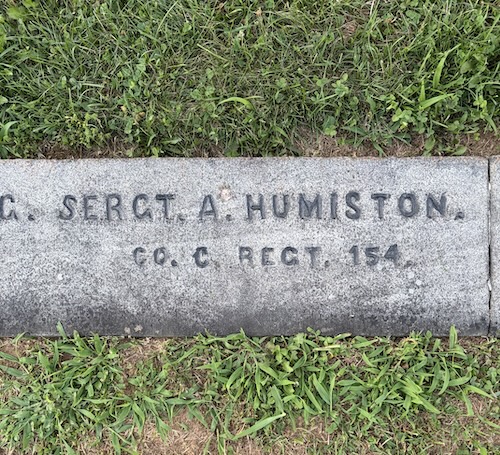
The grave of Sergeant Amos Humiston at Gettysburg National Cemetery. Stephen Grant Beukema Photo.
It appears as though Amos was a man of some depth and adventure. He spent several years at sea as a whaler (Dunkleman p3). On returning to Tioga County, he married Philinda Smith and eventually settled in the western New York village of Portville. The Humistons had three children together: Frank, Alice, and Frederick. Through his subsequent letters written while away at war, it is obvious that he was a caring and loving husband and father. Who would have known at that point that those children and a succeeding photograph of them would play such a role in revealing their father‘s identity and establishing their legacy?
The Civil War erupts, and the 154th New York Volunteer Infantry Regiment is formed in Jamestown, New York. Amos, although several years older than the average Civil War soldier, signs up and joins Company C, which is formed from Portville men. The 154th were joined to fight in Coster’s Brigade under Oliver Howard’s 11th Corps.
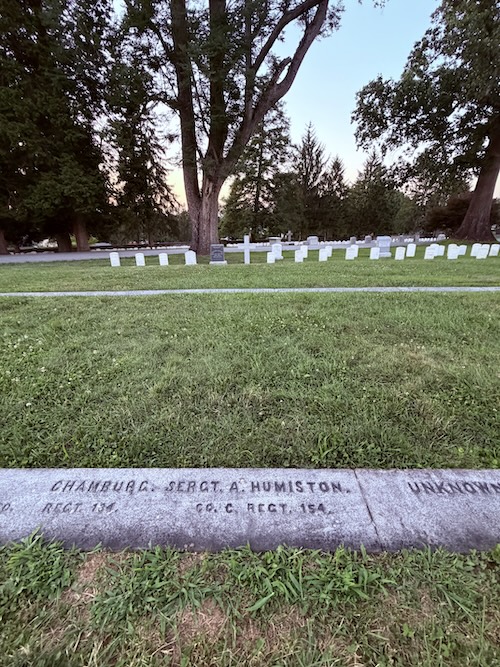
Gettysburg National Cemetery. Stephen Grant Beukema Photo.
Humiston is promoted to the rank of sergeant and is wounded at the battle of Chancellorsville, the 154th NY loses a third of their regiment there. At Chancellorsville, Confederate generals Lee and ‘Stonewall’ Jackson shockingly flanked and routed General Hooker’s Army of the Potomac. General Oliver Howard’s 11th Corps-which Sergeant Humiston and the 154th were a part of-were greatly embarrassed. The battle of Gettysburg would forever make up for that.
Most of us know what a historically important battle, the Battle of Gettysburg, was. It was the bloodiest battle of the Civil War. Three major battles over three days, July 1-3, 1863. Any one of those days’ battles would be considered a devastatingly violent major battle of the Civil War.
In the late afternoon of Wednesday, July 1, 1863, Sergeant Amos Humiston of Company C of the 154th NY found himself in the midst of some incredibly violent fighting. Ordered into a ‘delay and defend’ role in that segment of the Union Army. The 154th found itself in an unavoidable confrontation with a larger Confederate force. An attempt was made to slow down the Confederates from quickly sweeping through the Borough of Gettysburg and seizing the advantageous high ground of Cemetery Hill.
More specifically, in an area known as Kuhn’s Brickyard, Coster‘s Brigade came under attack by two of Jubal Early’s Confederate brigades-they were at a three to one disadvantage. As a result, Humiston was killed in a fight known as the ‘Battle of the Brickyard.’
Three days later, both armies had left the battleground. What remained were thousands of wounded to be tended to as well as thousands of bodies to be buried.
Sometime on or about July 5, Humiston’s body was discovered near railroad tracks close to Stratton and York Streets in downtown Gettysburg (National Park Service).
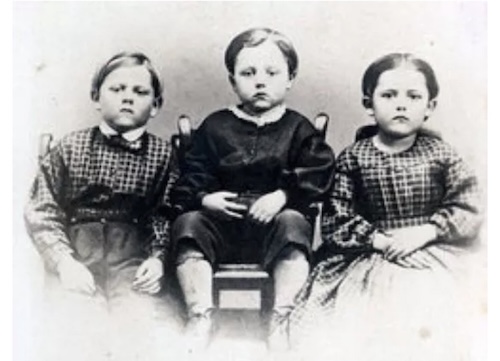
In the days before dog tags, there was no uniform way of identifying bodies of soldiers. Fortunately, in the previous month, Philinda had sent her husband Amos a letter. In that letter was an ambrotype picture of their three children: Frank, Frederick and Alice-ages eight, four, and six, from left to right in the picture.
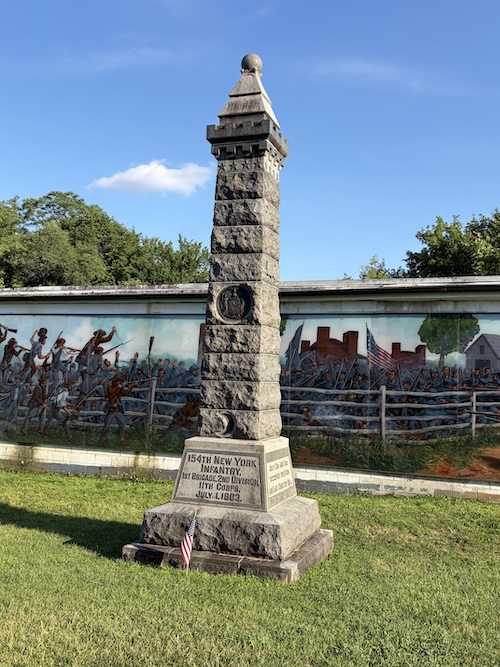
Monument to the 154th NY at the Brickyard in Gettysburg. Stephen Grant Beukema Photo.
When Amos’ body was recovered, this picture was the only thing that could offer any possibility of identifying who he was.
A local tavern owner named Schriver displayed the ambrotype and told the story in his establishment located on the Chambersburg Pike. From this continued exposure, the picture and the story gained the attention of Dr. John Bourns from Philadelphia. Through his connections, Bourns, seeking to resolve this unfortunate mystery, facilitated the proliferation of the story through several newspapers. He also arranged to have several copies of the photo made to aid in verifying, if necessary. Additionally, Bourns also kept track of where Sergeant Humiston’s body had been temporarily interred on the battlefield.
From there, a detailed description of the ambrotype was published. An interesting story of a Battle in which a heroic Gettysburg casualty was clutching a picture of his three children as he lay dying. This story would gain serious media coverage that reached national attention. The original article, entitled “Whose Father Was He,” appeared in the Philadelphia Inquirer on October 19, 1863. Soon after, the article began to appear nationwide. Eventually, the moving description and story was run in a Presbyterian newsletter and reached the Portville area of New York. After a special copy of the ambrotype was sent to Philinda for verification, the identification of Sergeant Amos Humiston was officially confirmed and revealed.
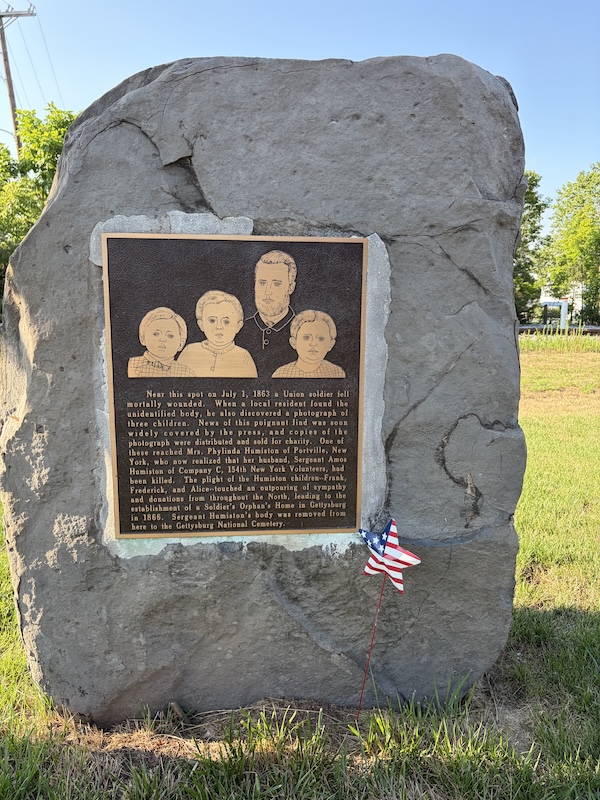
Memorial marker for the location where Humiston fell on 1, July 1863. Stephen Grant Beukema Photo.
Due to the fascinating medium of photography, and the care and concern of several people like Dr. Bourns, Amos Humiston would not have to become another statistic. He would not be another unknown soldier. His three children would now know how, where, and when their father died. Sergeant Humiston’s body would also be reinterred in the new Gettysburg National Cemetery. Amos would not be buried as one of the other 979 unidentified graves there.
Additionally, from this incident, the National Homestead Orphanage was started in Gettysburg. A potential refuge for widows and orphans of the thousands lost at Gettysburg. Some of the funding for the orphanage was gained through the sale of pictures of the children. The small photos were relatively mass produced in a process known as ‘carte de visite.’
This story of people’s bravery, honor, resolve and love is a legacy that should never grow old.
Additional notes of interest: The fighting on Day One at Gettysburg at Kuhn’s Brickyard was a serious fight with nearly 800 casualties (total from both sides). The 154th New York sustained a 77% regimental loss. This constitutes over 200 casualties-killed wounded or missing. This puts the 154th NY as the fourth or fifth most devastated regimental unit from the Union army at the Battle of Gettysburg.
It places them somewhere between the horrific losses of the 1st Minnesota as General Hancock ordered them to fill at gap on Day Two, and Colonel David Ireland’s 137th New York Regiment out of Binghamton, New York. What the 137th New York accomplished on Culp’s Hill on all three days of the battle is legendary.
Sources:
No AI was used in the writing of this article.
-National Park Service: Amos Humiston, The 154th NYVI.
-Dunkelman, Mark, H “Key To A Mystery,” American History, June 1997. And “Amos Humiston: Union Soldier Who Died at the Battle of Gettysburg,” 1997.
(Dunkelman is the author of several books, including focus on the 154TH New York Volunteer Infantry and Amos Humiston. Dunkleman is also the artist who painted the 80 foot-long mural in honor of the 154th and Humiston off of Coster Avenue in Gettysburg.)
-Letter from Sgt. Amos Humiston of the 154th NY Infantry to his wife Philinda on May 9, 1863.

Be the first to comment on "AMOS HUMISTON: Owego Man, Gettysburg Reveal"