
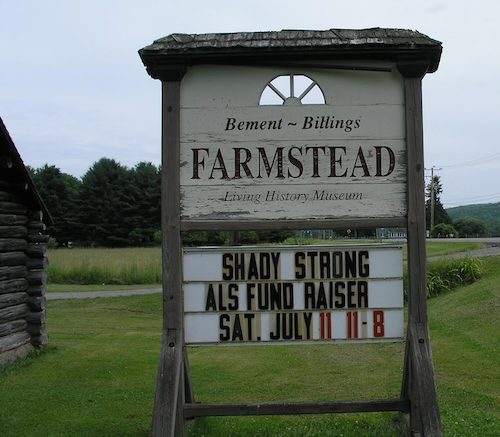
As a special way to “piggyback” the Semiquincentennial (America’s 250th), the Newark Valley Historical Society is offering “enhanced” programming on weekends. This also gives the guides at the Farmstead, Society members, and other community members an opportunity to share their special skills, talents, and/or knowledge.
On Saturday, July 4, Ed Nizalowski, the current Director of the Farmstead, will share his experience and knowledge of the flute and saxophone. Ed’s first pursuit was music education; he attended the Crane School of Music in Potsdam for three years (1965 to 1968) majoring in flute before switching to English.
After taking his flute out for a year, he discovered that he had the ability to improvise. He linked up with some musicians in Florida, and coming back north, he played with a variety of groups; at one point, he had a jazz quartet, Solaris (named after the science fiction novel by Stanislaw Lem).
Ed performs a single act as “Dr. Jaz,” and can be seen playing at the Ray Shaver Depot prior to the regular musical act. He likes to play a mixture of Baroque flute music and tunes popular a century ago (give or take a decade or two). He will have a number of “primitive” flutes, along with his C flute, piccolo, alto flute, alto sax, and soprano sax.
On Sunday, July 5, Ed will give a tour of the trees close by the Farmstead. Ed has been a “tree hugger” most of his life and credits his father for instilling this value in him. For a number of years, his father raised and sold Christmas trees and did some landscaping. The trees around the Farmstead are a mixture of volunteer-planted ones. They include sassafras, black locust, hawthorn, Norway spruce, American elm, black cherry, shagbark hickory, and sycamore. Ed is especially interested in stories related to trees, how their use has changed over time, current threats to particular species, and myths related to trees.
The tree tour will end with a visit to “Asa,” the current co-champion shagbark hickory for New York State. Champion trees are determined by a point system that awards one point for each inch of circumference, each foot of height, and every four feet of crown spread. The Newark Valley tree is not that tall (77′) and doesn’t have much crown spread (56′), but its girth of 174” puts it into the champion category, giving it 263 points.
The Farmstead also has a cross section of an American elm that had been the state champion for a brief period of time. This has been very valuable for school tours when explaining dendrochronology and the problem of invasive species.
When a DEC forester from Cortland measured “Asa” about two years ago, they were told that it was co-champion with a tree in Westchester County. If two trees are within five points of one another, they are listed as co-champions. Currently, the Newark Valley tree is the only one on the state registry that can be accessed online. It’s a bit confusing. Something else that is confusing is why this tree was left in that particular spot. Perhaps Asa Bement, the first settler, decided to leave the tree so he wouldn’t have to go so far into the woods to get his hickory nuts.
The Bement-Billings Farmstead is located one mile north of the village of Newark Valley on Route 38 (9241 State Route 38). Weekend tours are available from noon to 4 p.m., July through September. The cost of a tour is $3 for adults and $2 for students (ages five to 16).
Visit www.nvhistory.org to learn more.

Be the first to comment on "Celebrations at the Farmstead"