
By Greg Zyla
In July 2024, I wrote a column titled “Electric Car Concerns Started With the Cart Before the Horse.” At the time, that headline alone triggered reactions I never intended. I was labeled anti EV and anti green simply for questioning the order in which electric vehicle policy was being rolled out.
Today, those labels have largely disappeared.
Not because I changed my position, but because the conversation finally caught up with reality.
The original argument was simple: You cannot expect mass adoption of any form of transportation before building the infrastructure that allows it to function properly. You cannot mandate vehicles while ignoring the highways on which they must travel.
Transportation in this country has always followed the same basic sequence: Roads first. Fuel second. Vehicles third.
The Pennsylvania Turnpike proves this point.
When the turnpike opened on Oct. 1, 1940, I was not yet on this earth, having been born in the summer of 1949. Still, I remember the excitement surrounding later expansions, the growing service areas, and especially when the Pennsylvania Turnpike Northeast Extension opened in 1955. That expansion featured the Blue Mountain Tunnel, which at the time was considered a major achievement in highway construction.
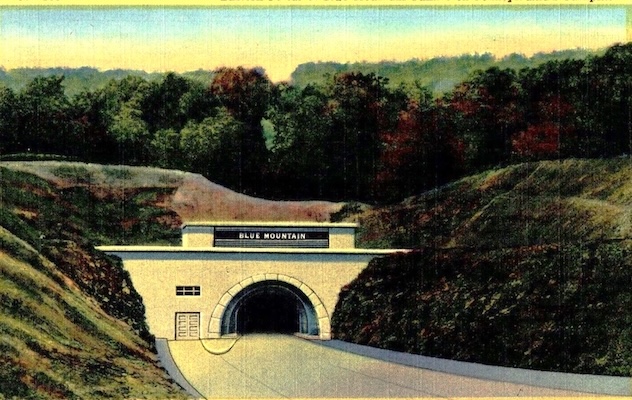
Family road trips taught this author the importance of building transportation infrastructure properly. Shown is the Pennsylvania Turnpike Northeast Extension Blue Mountain Tunnel. (Pennsylvania Turnpike)
I remember when my dad first took the family on the Northeast Extension during our regular trips from Vineland, N.J., to Ranshaw, Pa. We traveled in his 1955 Plymouth Savoy and later his brand new 1961 Chevrolet Bel Air.
Those trips became unforgettable for a young boy already fascinated by cars and racing. At just seven years old, the first time we approached the tunnel opening at the base of Blue Mountain, I immediately told my dad to blow the horn inside the tunnel.
To make those trips even more memorable, my dad often used the Chester Bridgeport Ferry, which connected the two river towns by water. From 1930 until 1974, the ferry carried commuters, truckers, vacationers, and generations of families across the Delaware River. Instead of crossing via nearby toll bridges, including the Delaware Memorial Bridge, that slower crossing became a cherished part of our journey.
By the late 1950s, the Delaware Memorial Bridge charged about 50 cents per car one way, cheaper than the Chester Bridgeport Ferry’s 75 cents each way. Still, the ferry offered something the bridge never did. It offered a boat ride, the wonder of water, and family memories that remain vivid to this day. Thanks, Dad.
When the Commodore Barry Bridge opened on Feb. 1, 1974, the ferry quietly slipped into history, having fully served its purpose in an era when crossing the river felt special. Before I drift too far into nostalgia, I promise to revisit a Vineland to Ranshaw road trip in a future column.
Back to the EV update.
Long before policy debates and federal mandates, my understanding of transportation came from the road itself, shaped by those regular trips and the sights along the way.
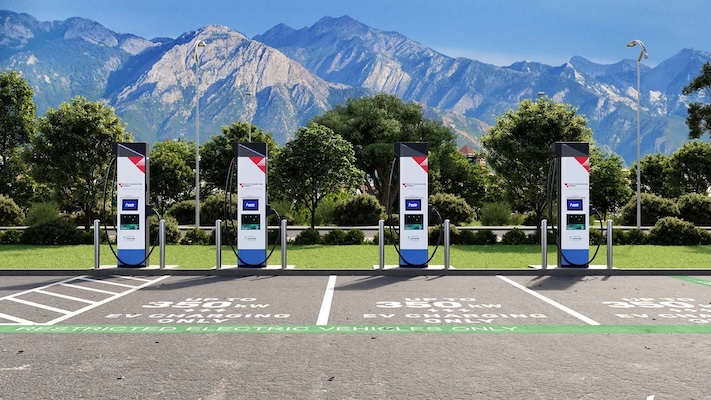
More electric vehicle recharge stations are finally being built along the nation’s highways. This is a Rocky Mountain recharge center in Utah. (Google)
To bring the cart before the horse argument full circle, the electric vehicle push skipped the proper sequence. The vehicle came first. The charging infrastructure came later or, unbelievably, not at all.
Despite the lack of nationwide charging stations, millions of EVs were built and introduced. Outside of states such as California and Florida, highway charging coverage was often inadequate. In states including North Dakota and even Illinois, long distance highway travel became a legitimate concern for EV owners.
Many rural areas had very few fast-charging stations, and some failed entirely in snowy, subzero conditions. During near zero temperatures in Chicago, cables froze, chargers stopped functioning, and drivers abandoned cars mid charge when equipment failed.
Ford Becomes the Real-World Proof
No automaker illustrates the consequences of improper introduction more clearly than Ford, and more recently, Dodge.
Ford committed early and publicly to electric vehicles. The Mustang Mach E and the F 150 Lightning launched with tremendous enthusiasm. Initial sales were strong, and early headlines suggested the transition was well underway. Once excitement gave way to real world ownership, however, the picture changed.
By 2025, Ford acknowledged billions of dollars in annual losses tied directly to its EV division. Sales of the F 150 Lightning declined sharply as the truck failed to deliver what many truck owners demanded. Production was paused. Several future EV programs were delayed or canceled outright. Ford has not formally canceled the Lightning, but production has been halted indefinitely with no restart date announced, effectively removing the F 150 Lightning from the market.
At the same time, Ford’s hybrid vehicles surged. The Maverick Hybrid and the F 150 Hybrid became strong sellers. Ford sold more than 228,000 hybrid vehicles in 2025, its strongest hybrid year ever. The result underscored a clear reality. Consumers embraced electrification when they felt secure and confident behind the wheel.
Drivers were not rejecting electrification. They were rejecting anxiety and inconvenience. Hybrids offered reassurance their fully electric counterparts could not yet match.
Ford executives eventually stated what many drivers already understood. Without reliable nationwide charging infrastructure, especially along highways, electric vehicles failed the test of proper execution.
GM, Stellantis Hit the Same Wall, Tesla Hasn’t
General Motors sold approximately 170,000 EVs in the United States during 2025, more than double Ford’s EV volume of roughly 84,000 units.
Momentum faded quickly. GM’s EV sales fell sharply in late 2025 and early 2026. U.S. deliveries dropped 42 percent in the fourth quarter of 2025 and another 19 percent in the first quarter of 2026.
Stellantis experienced similar challenges. The electric Dodge Charger was introduced largely on a muscle car whim. Sales collapsed, with gasoline powered Chargers outselling the electric model by a wide margin. It was another reminder that technology cannot outrun market readiness. Mopar loyalists were raised on 440 Six Packs and 426 Hemis, a subject explored in last week’s column.
And Tesla, you might be wondering?
Tesla succeeded because it built reliable charging infrastructure early and made EV ownership easy long before mandates attempted to force consumer adoption. In 2025, Tesla sold roughly 350,000 Model Y vehicles compared with Ford’s 51,600 Mach E units. The Mach E remains in production, unlike the F 150 Lightning, which is good news for Ford. Still, the volume difference tells the larger story.
Infrastructure Is Finally Growing
This is where the conversation changes.
Today, the United States has approximately 85,000 publicly accessible EV charging stations, representing more than 275,000 individual charging ports nationwide. This is a meaningful increase from where the country stood when my original column ran.
Concerns remain. Only about one quarter of those ports are high speed DC fast chargers suitable for highway travel. Most remain Level 2 chargers designed for vehicles parked for extended periods, not long-distance travel.
Infrastructure is finally being built, but it arrived after mandates, not before them. That gap explains much of the public resistance and frustration.
The Home Charging Theory
The idea that most EV owners would simply charge at home ignored how millions of Americans actually live. Apartment residents, condominium owners, street parkers, long distance commuters, contractors, travelers, and campers all face different realities. That’s why this charge at home premise failed.
Gas stations exist everywhere because they had to. Until charging stations are equally common, visible, and dependable at the same highway exits, electric vehicles remain a compromise rather than a true replacement.
From Critic to Credibility
For a time, questioning these realities made me a target in the EV discussion. Being early with practical concerns meant standing apart from mandated optimism. As automakers slowed production and governments adjusted expectations, the tone shifted.
Then came a moment some readers noticed.
When the president publicly stepped back from aggressive EV mandates and instead emphasized infrastructure, affordability, and consumer readiness, longtime readers contacted me. More than one said it sounded as though he was reading my column.
I make no claim beyond that observation. But the framing had clearly changed. The cart had been placed before the horse, and policy finally acknowledged it.
The Lesson That Finally Stuck
The good news is that the lesson appears to have been learned, better late than never.
Highway charging is expanding. Truck stop hubs are growing, and even Buc-ee’s is entering the conversation with charging upgrades. Reliability standards are improving.
Electric vehicles will not succeed because they are mandated. They will succeed when they are easy to live with.
That has always been my point.
Put the horse back in front of the cart, pave the highway properly, build nationwide recharging stations, then let consumers decide what they want.
Author’s note: Data referenced in this column come from the U.S. Department of Energy’s Alternative Fuels Data Center, automaker reports, and reporting by GM Authority, Old Chester, Tesla, Electrek, AutoGuide, Ford Authority, and Yahoo Autos.
(Greg Zyla is a syndicated auto columnist who welcomes reader interaction on collector cars, automotive nostalgia, and motorsports. He can be reached at extramile_2000@yahoo.com or 303 Roosevelt St., Sayre, Pa. 18840.)

Be the first to comment on "Collector Car Corner / Cars We Remember; From Road Trips to Recharge Stations: An EV Reality Check"