
Contributed by CCE Tioga County – Master Gardener Volunteer Program —
Are you tired of winter and impatient to garden again? If so, consider winter sowing. It’s a method where you plant seeds in containers and place them outside for the winter. The seeds germinate when the weather is right for them.
There are several advantages to winter sowing. You can start gardening earlier, you don’t need space inside for containers, and there is no need for grow lights or heat mats. In addition, this method satisfies the cold stratification (a period of cold temperatures) requirement of many seeds. This will happen naturally outside rather than in your refrigerator or garage.
You can begin sowing seeds at the winter solstice and continue throughout the winter.
Materials needed include any kind of seed work except those for tropical plants. Try marigolds, cosmos, bachelor buttons, sunflowers, bee balm, or tomatoes, for example. Plant your perennial seeds first. You will need potting soil (not seed-starting mix), a bucket, and water.
Clear or translucent plastic containers. Milk jugs are commonly used, but other plastic containers may be used if they are large enough for soil and seedling growth.
You will need scissors or a knife; a tool to make holes, an awl, a drill, a knife, etc.; duct tape, paint, or grease pen (regular markers fade in the sun), and something to keep the containers from blowing over in the wind.
The steps
As always, be very careful when using sharp tools. Add potting soil to the bucket and water it until moist, but not saturated. Remove the caps from the jugs. Add holes to the tops of the other containers so that moisture can get in. Make holes in the bottom of all containers so excess water can drain. Cut three-quarters of the way around about halfway up the jug, leaving a hinge for opening and closing the top.
Fill the container with 3 to 4 inches of soil. Add seeds. For tiny seeds, sprinkle a few on the surface. For larger seeds, plant a few and cover with just a little soil.
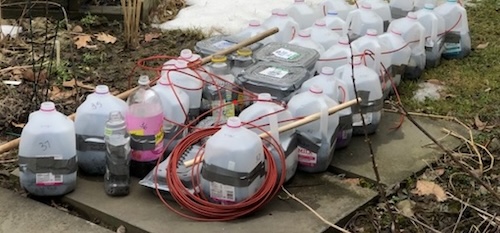
Gently press the seeds down and sprinkle them with a little water. Label with the type of seed and include a backup label inside. Tape it shut and place it outside where it will get sunlight and snow/rain.
Protect containers from the wind, perhaps by putting a pole through the jug handles or tying them together.
That’s it! You shouldn’t need to do anything until the weather warms up in the spring. If the temperature does rise above freezing and there is no condensation in the container, gently add water.
Once the seedlings pop up, make sure the soil doesn’t dry out and open the top on warm, sunny days.
Find more ideas on Pinterest or YouTube for “winter sowing,” or contact CCE Tioga with specific questions at (607) 659-5694 or email Tioga@cornell.edu.

Be the first to comment on "Winter Seed Sowing"