
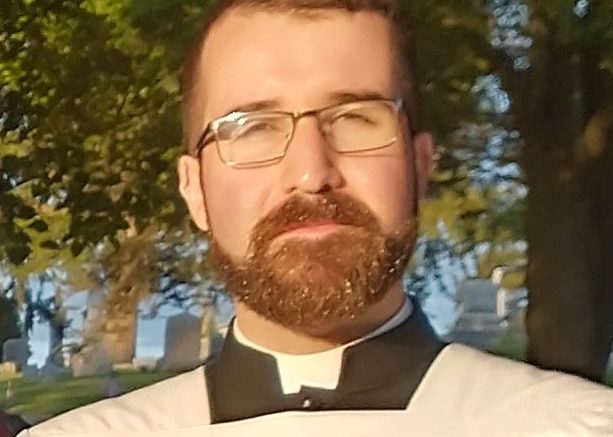
By Fr. Jim Muscatella, Blessed Trinity and St. Patrick’s Parishes —
“Have you seen the donkey in the Nativity scene?”
I turned to see one of our parishioners poking her head into the sacristy at St. Patrick’s. It was St. Stephen’s Day, Dec. 26.
“Have you seen the donkey,” she asked again, noticing my confusion as I turned.
I had spent plenty of time with that crèche in the days surrounding Christmas. The one on display in St. Patrick’s had been lovingly arranged by devoted volunteers, and I was among many who paused in wonder at the recreation of Jesus’ Nativity.
The donkey, however, I had failed to see. Alone, I journeyed over to the crèche and noticed that there, amidst the camel and shepherds who had journeyed to be near the Holy Family, reclined a most beautiful donkey – and at this, the priest, alone in his church on a snowy St. Stephen’s Day, smiled and prayed.
If the world did not hold a nostalgic tenderness for the now-familiar Nativity scene, calling a donkey “beautiful” would be quite a stretch: our short and stout beast of burden lacks the stately stature and symmetry of his most picturesque cousin, the horse. From days of old, it was the horse that stood symbolically for strength, honor, and grace. Our donkey was seen as a silly, stunted substitute – as nature’s mocking mimicry of the best and highest players of creation; useful, perhaps, but far from the peak of desirable perfection.
Christ came on Christmas night, however, looking to bring all of creation to a new, unimagined splendor. The King of all Creation, coming as a poor and lowly child in the cold and dark of that winter’s night, brought with Him a ray of new light. He shines it on all those who would be gathered near to Him – and the warmth of His love seems to recreate us all, newly splendid and aright.
None of the Gospel accounts mention either our donkey or his stalwart companion, the humble ox, near the manger. The book of Isaiah, however, longingly anticipates our Messiah’s coming hundreds of years before His birth in time – and prophetically places both ox and ass alongside the Christ Child.
“Hear, O heavens, and listen, O earth, for the LORD speaks: Sons have I raised and reared, but they have rebelled against me! An ox knows its owner, and an ass, its master’s manger, but Israel does not know; my people have not understood.” (Isaiah 1:2-3)
The prophet here places God’s beloved people, who in straying from their God have become deaf to His call, playfully alongside the images of the ox and the ass (or donkey) – animals the Chosen people often associated with stubbornness and stupidity.
How delightful it is, then, that alongside Christ even these burdened beasts become beautiful – in Christ’s moment, their follies are brought to fulfillment.
The “dumb” ox is shown wise in his silent reverence of our sleeping Savior; the “stubborn” donkey is beautifully steadfast alongside our resting Redeemer.
Years from that Christmas night, Christ will reunite with His stablemate for the procession of Palm Sunday. G.K. Chesterton’s “The Donkey” imagines the silent gratitude of that redeemed beast:
When fishes flew and forests walked
And figs grew upon thorn,
Some moment when the moon was blood
Then surely I was born.
With monstrous head and sickening cry
And ears like errant wings,
The devil’s walking parody
On all four-footed things.
The tattered outlaw of the earth,
Of ancient crooked will;
Starve, scourge, deride me: I am dumb,
I keep my secret still.
Fools! For I also had my hour;
One far fierce hour and sweet:
There was a shout about my ears,
And palms before my feet.
The beast had become beautiful since he had borne Christ. For Catholics, Holy Mass is the privileged moment of prayer with Jesus – from it, we are sent (“dismissed,” from the Latin “Missa”), to bear Christ to the world. If we are to bear Christ, however, we must first be drawn near to Him – to the wood of His crib, His Cross, and finally His altar. On these He has laid Himself down for us – from these, His presence makes all things, and us in them, beautiful and new.

Significant—-the donkey was present in the Incarnate birth of our Lord on earth and there again by choice the time of ending his life on earth.