By Greg Zyla —
Q: Greg, I enjoy your articles on muscle cars from the 1960s. However, sometimes I feel Ford isn’t mentioned as much as GM brands and those cool Chrysler muscle cars with 440 and 426 Hemi engines. Can you give me more on the development of Ford muscle cars, from Thunderbolt to Galaxie 427? Thanks, David L., a lifetime Ford lover from Connecticut.
A: David, I’m happy to help, and one thing we both agree on here in April of 2025, Ford and its Mustang, in many varieties, is perhaps the hottest-selling muscle car of all time. We know this to be true because Mustang’s top competitors, the Dodge Challenger and Chevrolet Camaro, aren’t being built any longer.
So, let’s go back to the days when you cruised the boulevard in 1962, and a Ford Galaxie with a tri-power 406 with 405 horses pulled up alongside your 409 Chevy. Both were potent, but the 409 came with two four-barrels and produced 409 horsepower. That Ford Galaxie wasn’t too competitive on the drag strip, but on the NASCAR oval tracks, it dominated many races and was in the ballpark with Pontiac’s 421 Catalina, the other big winner in NASCAR. For those who relied on the ’62 409 Bel Air Chevy, they found that winding the 409 over 6,000 rpm usually meant something was going to break.
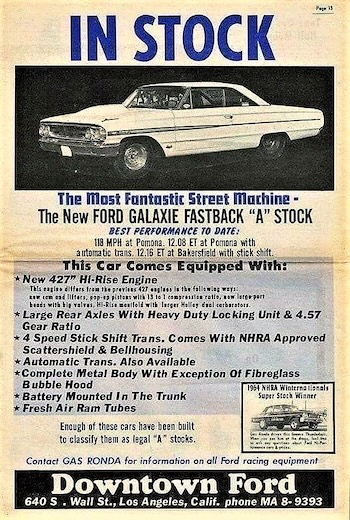
This ad for a 1964 R Code Galaxie officially kicked off Ford’s dedication to high-performance cars, resulting in drag race victories and a dominating force on the NASCAR ovals. (Zyla collection)
However, thanks to Rex White winning the final race of the ’62 season, the Atlanta Dixie 400, it was the only superspeedway win for the 409 that year. On the short tracks, it was a different story as White and Ned Jarrett combined for 13 wins.
Fortunately, Ford was busy staying competitive on the ovals and developing its street machines and drag race cars. This is why I feel 1964 was the pivotal year for Ford and true high performance. The 1964 Fairlane Thunderbolt 427 was a true masterpiece, although only 100 were ever built to adhere to an NHRA Drag Race rule.
These “drag race only” Thunderbolts were sent to designated racing teams and dealers involved in the sport instead of being offered to the public. Unlike the 1964 GTO, which was available to the public, Ford’s Thunderbolt was a once and done experiment like the Plymouth Barracudas in 1967 that came with the 426 Hemi under the hood, but only a few were built for select drag racing teams.
Yet when it comes to the full-size Galaxie, it’s the full-size 1964 Galaxie 427s in Q or R-Code dress that merit a top mention. The ’64 Ford Galaxie was not only a good-looking car, but it also offered buyers a choice of the remarkably successful 427 Hi-Riser engine. Available in three versions, two were available to the public, with the third a NASCAR-only race version.
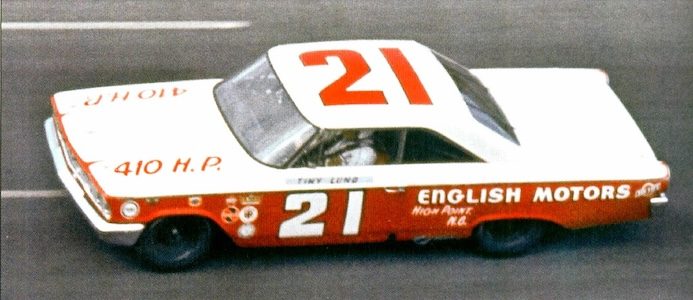
In 1963, Fords took the top five finishing positions at the Daytona 500, led by Tiny Lund in the Wood Brothers No. 21. Lund was a fill-in driver for Marvin Panch, whom Lund helped save from a burning sports car in a race at Daytona. (Wood Brothers)
The “normal” Q-code 427-cid engine, which sold over 3,200 units to consumers, cost $461 for a 410-horse single quad version and $570 for the dual-quad, 425-horse setup. This street version 427 had a 10.7:1 compression ratio and was suited for daily driver status. These street versions ran very well and were very affordable. However, these large Galaxies became the darlings of the drag racing world when the new R-Code 427 Hi-Riser found itself between the frame rails as a drag race option with full company backing, both oval and drag racing.
Ford management knew that winning at the drags and in NASCAR sold cars, so it quickly withdrew from the Automobile Manufacturers Association ban on factory-sponsored racing that started in 1956, which Ford had agreed to participate in. However, the Big Three agreed to non-participation as well, but they all “cheated” as best they could.
Instead of hiding its high-performance options, Ford introduced its “Ford Total Performance” program in ‘64, which highlighted its performance engineering abilities to attract both young and older race enthusiasts. Again, the “win on Sunday, sell on Monday” theory was in high gear, and Ford was not to be denied. Case in point” in 1963, Ford took the top five places in the Daytona 500, with Tiny Lund winning for the Wood Brothers in the famous No. 21 Galaxie.
In response, General Motors had nothing like this to offer, although Chrysler was ready to join Ford with its new factory-backed 426 Hemi. For eight long years, Ford and Chrysler dominated NASCAR with nary a competitive Chevy in sight. Matter of fact, Chevy wouldn’t find victory lane at a major NASCAR track from 1964 to 1971 when Bobby Allison finally won Atlanta in a ’72 Chevrolet. Prior to that, it was Ford, Mercury, Plymouth, and Dodge scoring all the big race wins.
Furthermore, when a car company like Ford puts together a program that fills the needs of every performance enthusiast, from street to drag to oval racing, it deserves to receive proper credit. That’s why in previous columns, I mentioned the 390 Ford Tri-Power engines from 1960 and 1961 as forerunners of this 1964 Total Performance program, along with the 1962 and 1963 earlier versions of the 406 and 427. Today, fans can expect one of the 1964 Galaxie R-Code drag car specials to go for $135,000 and up if one shows up at a Barrett-Jackson or Mecum Auction.
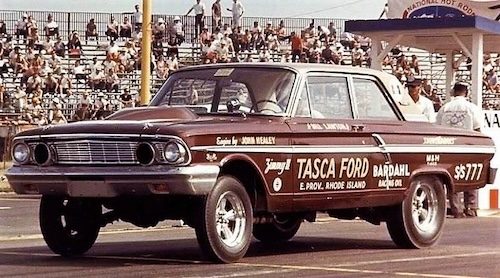
The Ford Thunderbolt was one of Ford’s top drag race muscle cars. (Ford)
The attached ad for a 1964 Galaxie 427 Hi-Riser Special shows the drag car was based on the lighter weight option that Ford introduced in 1963. This option featured fiberglass body panels, aluminum bumpers, and other weight-saving ancillary items to lessen the car’s weight by about 300 pounds, or about three tenths less in quarter mile terms.
The drag ’64 Galaxie came with the 427-cubic-inch “Hi-Riser” V8 that was rated at just 425 horsepower. Notable is that the drag Galaxie came with both a four-speed manual and an automatic transmission, the latter which the Chrysler team of The Ramchargers had perfected in their corporate garages. So, although The Ramchargers were given much praise for perfecting an automatic that could manage the power of 426 Max Wedge and 426 Hemi, Ford, too, deserves credit for what they were able to accomplish in hooking up that big Ford power without disintegrating the automatic.
So, how did Ford make its automatic work in a market that was still caught up in the 4-speed popularity? (If you ordered a 427 R-Code, the 4-speed was standard.)
The special 427 R-Code race ready automatic was developed using Lincoln heavy duty automatic gearing hooked to a Ford Cruise-O-Matic torque converter with a special, lightweight aluminum housing. Other smaller parts were needed to manage the huge torque, and if you check the attached ad, you’ll see just how fast and consistent this Lincoln automatic was. Back then, when you could run the quarter mile as fast as a 4-speed with a pro behind the wheel, this R-Code Lincoln tranny’s value spoke volumes.
The last of the three 1964 427s that could be ordered was not available for public consumption. It was the 427 NASCAR version, built to meet NASCAR mandates to be legal to race. It featured a single Holley four-barrel carb, and the block was built to accept Ford’s “big horsepower” cylinder heads that some say resulted in a solid 525 horses.
Meanwhile, the R-Code 427 Galaxies’ hi-riser engine had special attributes the others didn’t. A unique intake manifold and cylinder heads raised the carburetors way above the valve covers, allowing for better airflow, more torque and the need for a special bubble hood that helped feed air to the carbs. Further, even though Ford sold an estimated 12,000 Q-Code street version Galaxie 427s that year, just 50 of the drag Galaxies were ever produced.
The list price for the 427 R-Code Hi Riser drag car was $4,150 for the automatic and $3,950 for the 4-speed, quite a bit higher than the standard Galaxie 500XL Q-Code 427. Although this R-Code V-8 could be dealer ordered, it was not really a street motor and would foul plugs after one night of cruising on the nation’s boulevards. Another negative was fuel mileage, estimated around eight per gallon city.
Notable Ford drag racers back then were Les Ritchey, Bill Lawton, Phil Bonner, Al Joniec, Gas Rhonda, Dick Brannan and even Mickey Thompson. Bob Tasca also deserves credit for his contributions to all the Ford drag race efforts from his still highly active Ford dealership in East Providence, Rhode Island.
Today, anyone that studies the who, what, when, where, and why of Ford high-performance, the 1964 year turns out to be what I consider its pivotal turning point. It was indeed 1964 that led to Ford’s overall success, especially in the years to come, regardless of racing class.
Thanks for your letter, David.
(Greg Zyla is a syndicated auto writer who welcomes reader interaction on auto nostalgia, collector cars, and motorsports at greg@gregzyla.com.)

Be the first to comment on "Cars We Remember / Collector Car Corner; Long live the muscle car Fords, from Thunderbolt to full-size Galaxie"