
By Greg Zyla —
The last time I wrote about the state of the electric car was April of 2022. Since then I’ve received many requests for more on the subject, since so much has occurred since then.
So, here’s my latest opinion on the subject with the assistance of AI as to why the building of the nationwide recharge centers has not occurred, even after an investment of from $7.5 million to $18 million in government funds.
To date, just eight government funded recharge centers have been built (yes, just eight). Further, I’m aware my columns are to be centered on nostalgic cars and memories, but I just can’t ignore the many requests from readers as to this current condition on the electric car (EV).
Thus, every day I watch as our car companies finally realize they’ve made major miscalculations by following our current administration’s “guidance” on converting to all-electric vehicles. As noted, I’ve written just one feature on this subject, calling for automakers to hopefully embrace hybrid technology instead of all-electric ideals to satisfy both the green advocates, and the consumer who wants an electric vehicle but can’t buy one for reasons I’ll try to explain this week.
Some ICE (internal combustion engine) manufacturers took the current administration’s “bait money” early on and tried to hit a goal of “by 2025 or 2030” we’ll all be selling lots of electric cars and eliminating ICE cars. Ford and General Motors (GM) went full speed forward, yet today are shutting down many of their robotic electric build platforms because the cars and trucks are not selling as anticipated. (They are overpriced, too.)
I’ve always felt these political demands and clean air initiatives are perfect examples of the “cart before the horse” dilemma. You just cannot wish an all-electric car or truck future into reality.
Trust me, I fully support clean initiatives, starting with clean water and removing all the plastic sitting on our ocean floor. I also support electric vehicles, but only when the industry is ready to sell, service, and recharge them quickly and efficiently.
So what, in my opinion, should we do about our electric car situation? Please read on, especially when I get to the catch-22 situation, and when I ask AI for their opinion?
My opinion starts here. Have you noticed the recent changes in Ford’s national advertising campaigns and several other major car builders? Instead of the past 100% all electric ideals, they have changed to “Ford has your answer, all-electric, hybrid or gas powered.”
Please excuse that this example may not be word-for-word correct upon presentation, but several foreign manufacturers have also changed their messages to this reality. (Including Volvo.)
These new ads centering on hybrids and ICE offerings are dead giveaways as to how things are really going when it comes to EV sales. The auto consumers in our country don’t want these all-electric vehicles because of range anxiety, ultra-high insurance rates, repair-ability, and the dismal lack of re-charge stations available across our great country.
To get to specifics, auto manufacturers looking at its unsold electric inventory should somehow try and re-tool to adapt installing a small 3- or 4-cylinder engine under the hood of the electric car or truck to eliminate the consumer’s ‘range anxiety’ that prevents them from buying an EV. Sounds crazy? Yes, it is. But it would eliminate the “can’t buy now” problem.
Further, the car manufacturers already make these vehicles, and they’re called plug-in hybrids.
Now, can you imagine if the manufacturers took all their government grant R&D monies and put it into making a plug-in hybrid that can go 200-miles before a recharge? I’ll bet the buyers would be lined up to sign on the dotted line. Yet even with a new plug-in hybrid that can go over 200 miles, you’re still just halfway home if we’re dealing with over the road trucking and driving. If there aren’t re-charge stations similar in number to our gas stations currently in use, we’ve hit a major stumbling block.
In all seriousness, this “gotta’ go green” government backed push will one day be looked on as perhaps the biggest blunder ever made by supposed “smart” automotive executives, resulting in bankruptcies of some major, big-name companies.
The all-electric auto folly is worse than those who promote turbine windmills for power. You know, those gigantic monstrosities that need to be rebuilt every 12 to 15 years, and have wings that CANNOT be recycled. (I was going to mention the 10 dead whales that washed up on a New Jersey shore a few months back because of alleged wind turbine windmills built in the ocean. (I’ll let you look that up.)
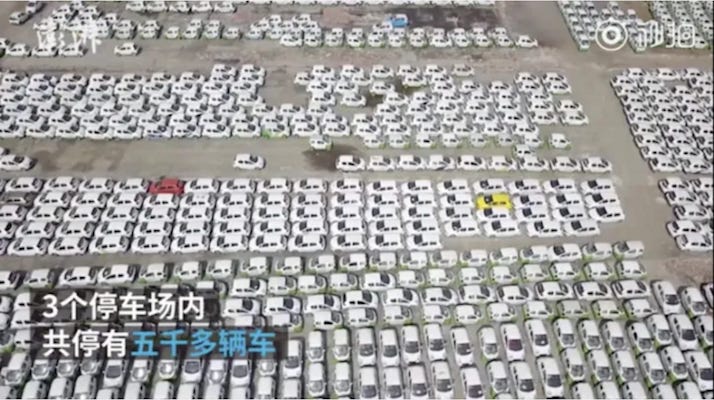
This Electric Car graveyard photo somewhere in China shows what is a dismal future for EV cars until the infrastructure to recharge them on the highways is set in motion. (Compliments China News)
Again, I’m all for clean air, clean water, and electric cars. But for goodness sake, why in the heck hasn’t this “green at any cost” been stopped? We should have learned our lesson from the first big, government funded, taxpayer grant solar power push; it was called Solyndra, a California-based solar panel company that went bankrupt after receiving $535 million in federal loan guarantees in 2009. In 2011 Solyndra filed for bankruptcy, and 1,100 employees lost their jobs that August. (Please look this up, too).
We simply didn’t learn from these horrendous solar power business failures. We just changed the “green energy soiled sheets” name, and politicians and lobbyists kept rolling out our tax dollars in the millions to “grant” to these newly named companies. All these green energy failures preceded our current all-electric green car mess.
Yes, I blame the politicians and lobbyists (the latter in securing an approval vote) via greasing the palms of friends and associates in the green business. These new companies are usually LLC’s for protection in the liability department, i.e. Limited Liability Corporation. These words are self-explaining that if someone sues, they will only get so much and nothing more. Talk about a perfect combination of protection in case you order several million solar panels and then can’t pay for them.
We’re in a bad way right now and I hope Ford and GM can stop the craziness (they are now trying) and return to common sense.
One day I believe we will have a successful electric car, but it won’t be anything like what they are trying to stuff down our throats today. No matter how much they discount these vehicles, they have proven they just don’t work that well, and re-charging on the highways is a crapshoot once you leave Florida or California.
If my readers have made it to this point, they’re probably wondering what the problem is since there are millions of dollars available from grants to build re-charge stations by the thousands.
So, as this column is research intensive, I asked AI (artificial intelligence) by Microsoft what the problem is and why? Why have only 18 recharge stations been built following the nationwide charade I call the “go green electric car” that has been rolling off the assembly lines for years now? Why the slow pace?
Here is AI’s answer.
Said AI, “The slow-paced development of electric vehicle (EV) charging infrastructure in the United States can be attributed to several key factors. Firstly, the decentralized approach to awarding contracts and constructing the network has created significant delays. Each state is responsible for its own planning, bidding process, and fund distribution, leading to inconsistencies and slow progress. Additionally, the excessive cost of setting up charging stations, which requires advanced technology and upgrades to the power grid, poses a major financial challenge.
“The situation is exacerbated by a catch-22 scenario: low Electric Vehicle adoption rates in certain states discourage investment in charging infrastructure, while the lack of infrastructure deters potential EV buyers. This cycle of low demand and limited infrastructure creates a significant barrier to faster development.
Federal Funding and Progress:
“The Bipartisan Infrastructure Law allocated $7.5 billion for electric vehicle charging infrastructure, with $5 billion dedicated to building a network of chargers along major highways.
As of now, only a few charging stations have been built with this funding. Reports indicate that seven to eight stations have been completed.
Ohio’s Specific Case:
“In Ohio, $18 million in federal funding was allocated to support the development of 27 new electric vehicle fast charging stations.
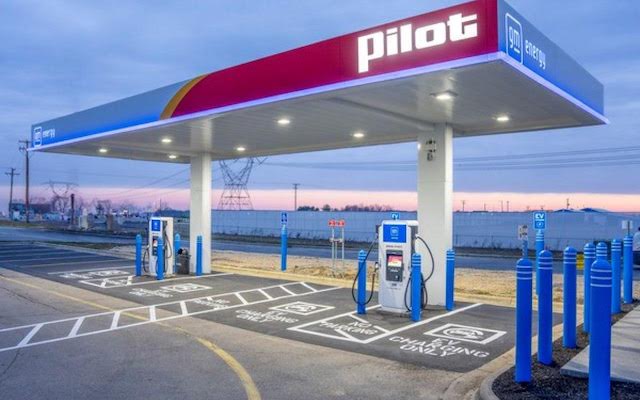
This funding is part of the broader National Electric Vehicle Infrastructure (NEVI) program. (Author note: As of July 21, there are a few operating recharge stations, one along Interstate 70 at a Pilot truck stop. The governor is expecting to receive $140 million more over five years to assist in building re-charge stations on all major highways. He also expects 27 fast charge stations will be in operation sometime in 2025.)
“In summary, while there has been some progress, the rollout of EV charging stations funded by federal programs has been slower than anticipated. The specific claim about only 18 stations being built with $18 million might be a misunderstanding or misrepresentation of the broader context of vehicle (EV) charging infrastructure in the United States can be attributed to several key factors. Firstly, the decentralized approach to awarding contracts and constructing the network has created significant delays. Additionally, the prohibitive cost of setting up charging stations, which requires advanced technology and upgrades to the power grid, poses a major financial challenge.
“The situation is exacerbated by a catch-22 scenario: low EV adoption rates in certain states discourage investment in charging infrastructure, while the lack of infrastructure deters potential EV buyers.” (Author note: This catch-22 ideology is attributed to GMAuthority.com, an Internet site not affiliated with GM. This cycle of low demand and limited infrastructure creates a significant barrier to faster development.)
Back to my opinion.
Sorry that AI repeats itself a lot, but I’m hoping GM and Ford can somehow keep their car and truck building afloat after losing hundreds of billions on electric vehicle hopes and dreams. Their electric vehicles are not selling, and now it seems the cost of battery replacement and crash repairs have skyrocketed, as have insurance rates for electric vehicles.
In ending, it’s time to get rid of the foolhardiness that has permeated in our current car building culture and realize that until the successful building of re-charge stations everywhere in the U.S. takes place, the EV is probably doomed. Until things change for the better (build nationwide recharge centers), the range anxiety of fully electric vehicles is real, and these prospective consumers won’t buy any EV, resulting in brand-new and used EVs sitting somewhere in what China calls its “unsold EV graveyards.”
Next week, we’re back to the nostalgia car questions, I promise. Thanks for staying with me during this different column.
(Greg Zyla is a syndicated auto columnist who welcomes reader interaction on collector cars, auto nostalgia or motorsports at extramile_2000@yahoo.com.)

Be the first to comment on "Collector Car / Cars we Remember; Electric car concerns started with the ‘cart before the horse’ breakdown"