
[By Greg Zyla]
I am going to answer a question I am still asked every week, especially since I have test driven nearly 1,750 vehicles since 1994. That question is simple: What car would you buy today after driving all those vehicles?
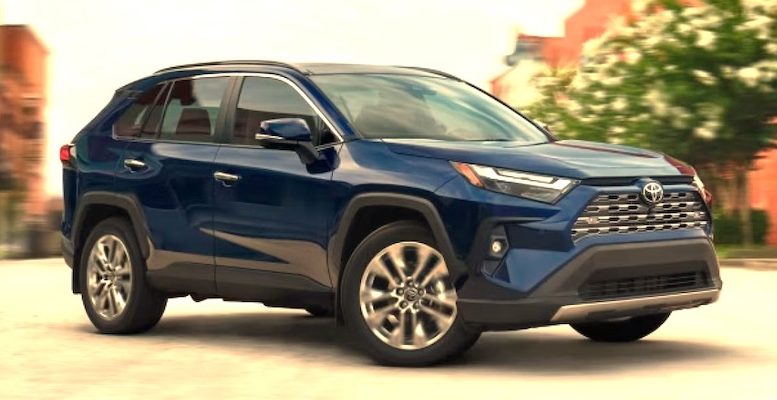
If I were buying a car or truck today, I would likely look for a used, off-lease or low-mileage Toyota. Whether it is a Camry, RAV4, Highlander, or Tundra, the odds of ending up with a dependable vehicle are strong.
This confidence is backed by numbers. Toyota remained the world’s top automaker in 2025, selling more than 11 million vehicles globally and leading the industry for the sixth straight year. In the United States alone, Toyota sold more than 2.5 million vehicles in 2025, an 8 percent increase from the year before.
The reason goes beyond reliability surveys and owner satisfaction scores. It traces back to a little-known American statistician who helped reshape how Toyota builds every vehicle.
Over the years, Toyota has become a benchmark for owner satisfaction, which I consider the most important part of vehicle ownership. I have subscribed to Consumer Reports for more than 40 years and look forward each year to its owner-satisfaction issues. While many automakers build excellent vehicles, Toyota consistently rises to the top when everything is considered. In fact, Consumer Reports again ranked Toyota as the most reliable brand in 2025, based on data from hundreds of thousands of vehicles. I expect similar results when 2026 is complete.
To understand how that happened, let us go back to the beginning.
Toyota’s story starts with Sakichi Toyoda, not Toyota. The company name changed because “da” can refer to a rice paddy, while “ta” carries no such meaning and can be written with eight brush strokes, a lucky number in Japan.
Born in 1867 into a small textile business, Sakichi became a skilled carpenter and inventor fascinated by machinery. He developed an automatic power loom that shut down if a thread problem occurred, improving efficiency and quality. His work helped shape Japan’s early industrial growth. He died in 1930 at age 63, before his company ever built an automobile.
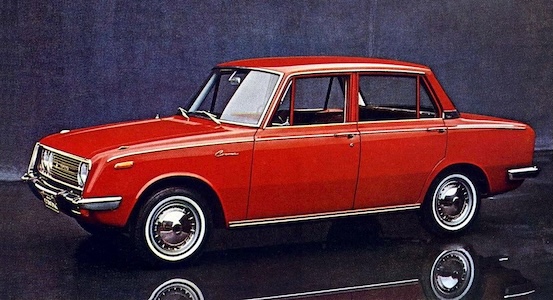
By 1958, five Toyota dealerships had opened in California, but the Toyopet Crown struggled on American highways. Designed for rougher Japanese roads, it was not suited for sustained speeds above 60 mph. The car sold for $1,999. (Toyota)
At the time, America dominated Japan’s small auto industry. Ford opened a plant in Yokohama in 1925, and General Motors followed in Osaka in 1927. Vehicles arrived in kits and were assembled locally, and by 1929 the two companies controlled much of the market.
Sakichi’s son, Kiichiro Toyoda, recognized the opportunity. After visiting Detroit in 1929 to study American automakers, he returned home determined to build cars in Japan. In 1933, he established an automotive division within the family’s loom company.
Early Toyota vehicles were heavily influenced by American designs. Engineers studied Ford and General Motors products and used reverse engineering to accelerate development. By 1935, Toyota produced its first car, a five-passenger sedan powered by a small six-cylinder engine and a three-speed manual transmission.
The company soon moved beyond imitation. By the late 1930s, Toyota had established its own research and development operations and began building vehicles under its own engineering direction.
Truck production helped sustain the company, especially when strong warranties resulted in consumer trust. By the early 1940s, Toyota was growing steadily. During World War II, it shifted entirely to military truck production, and the war ended before its facilities were destroyed.
The postwar years were difficult. In 1947, Toyota introduced its first new passenger car, but the company soon faced financial collapse. By 1950, production had fallen sharply, layoffs triggered a lengthy strike, and Kiichiro stepped down as president.
Then came a turning point. With the Korean War underway, the United States ordered thousands of trucks from Toyota. The contract provided vital revenue and helped save the company.
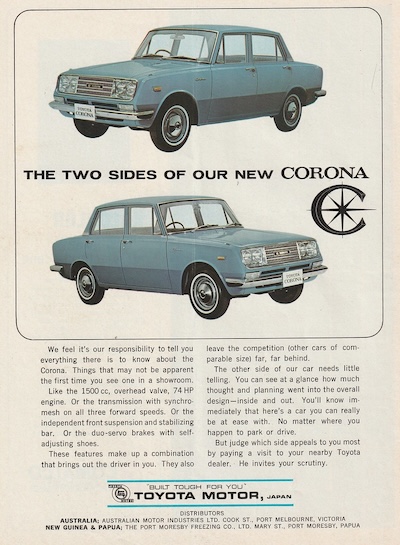
After selling only 286 cars through 1960, Toyota stopped exporting the Toyopet Crown to the United States, then returned in 1965 with the improved Toyota Corona. That same year, Toyota won its first Deming Application Prize for quality, an honor awarded annually in Japan since 1951. (Toyota)
Although Kiichiro was set to return as president in 1952, he died suddenly at age 57. Still, the foundation was in place. Toyota established a separate sales company in 1950, launched its dealership network in 1956 and entered the U.S. market soon after.
Early exports, such as the Toyopet Crown, struggled to meet American expectations. Sales were slow, and the company temporarily withdrew from the market. But Toyota learned quickly and returned with improved vehicles better suited to American roads.
This brings us back to why Toyota became what it is today.
In 1950, as the company was fighting for survival, American statistician Dr. W. Edwards Deming began teaching Japanese engineers and executives a new way of thinking about quality. His approach emphasized continuous improvement, cooperation across departments, and strong relationships with suppliers.
Those ideas took hold.
Deming’s influence helped transform Japanese manufacturing and played a key role in Toyota’s rise. Rather than focusing only on fixing problems after they occurred, companies were taught to improve systems so problems would not happen in the first place.
The results were dramatic. By 1965, Toyota earned the prestigious Deming Application Prize, awarded for excellence in quality control. It was a clear signal that the company had embraced a new way of building vehicles.
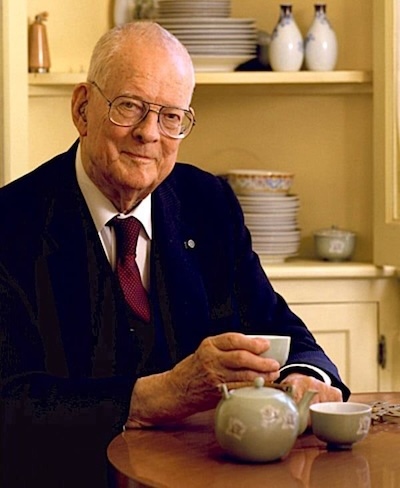
The Deming Application Prize, established in 1951, recognizes excellence in product quality control. The Deming Institute remains active more than 70 years after the first award. Shown is Dr. W. Edwards Deming at home, enjoying a cup of coffee. He died in 1993. (Deming Institute)
Ironically, Deming’s ideas were initially overlooked by many American automakers. His work gained wider attention in the United States after a 1980 television documentary highlighted Japan’s manufacturing success. By then, Toyota and others had already put his principles into practice.
Deming later advised major corporations, helping reshape modern management thinking. He continued writing and lecturing into his later years and died in 1993 at age 93.
Today, Toyota’s reputation for quality is no accident. It is the result of decades of discipline, learning, and a commitment to doing things the right way. Even as the industry shifts toward electrification and software-driven vehicles, Toyota’s focus on proven systems, including hybrids, continues to pay off.
Toyota is not alone in building excellent vehicles. Brands like Honda, Mazda and Subaru also deliver strong reliability and owner satisfaction, giving today’s buyers plenty of good choices.
So, when readers ask what I would buy, my answer is simple. I would choose a vehicle built on that kind of foundation.
(Greg Zyla is a syndicated columnist who welcomes reader questions on collector cars, auto history and motorsports at extramile_2000@yahoo.com or at 303 Roosevelt St., Sayre, Pa. 18840)

Be the first to comment on "Car Collector Corner: The American Who Helped Make Toyota Successful"