

Contributed by John Ricklefs —
What was known as the Exempt Owego Fire Police was first organized on Feb. 8, 1869. Right after the members were sworn to serve, Henry N. Hubbard, the captain of the newly organized unit, as according to the meeting minutes, “Requested the corporation to furnish white leather belts for the force, lettered Fire Police. On motion, the belts were ordered furnished.”
Joseph “Old Joe” S. DeWitt, by 1871, had taken the volunteer fire police members under his wing, which is where the organization remained until his death on April 17, 1876. The duties of the exempt ones, as mentioned in the Oct. 19, 1871, Owego Gazette, was to “remove goods from burning buildings to a safe distance; to watch over the same until claimed by the rightful owners; and to arrest (they having the same powers as other policemen) and confine in jail anyone caught pilfering and stealing goods saved from the flames,” but all that ended on March 4, 1878.
During the Board of Trustees meeting, it was so ordered that the Village of Owego Volunteer Exempt Fire Police Organization be disbanded. In 1877, the village had begun paying the room rent for the Fire Police meetings, and some of the trustees were not all too pleased with that. Eventually an urgent desire to resurrect the organization was introduced by a member of the village fire department board and the rest as they say, is history.
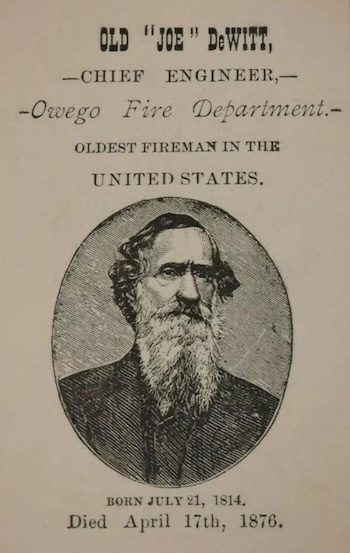
Old “Joe S. DeWitt.” Photo provided.
On Sept. 2, 1908, during an Owego Fire Board meeting it was recommended that a unit of men be organized who would be responsible for curving the issue of looting during and after a fire had been extinguished. According to the Sept. 3, 1908, edition of the Owego Times, “It shall be the duty of the members of the fire police to guard the property that has been removed from the burning building and to prevent outsiders from interfering with the work of the firemen or from molesting the property in the building or that which has been removed from the building.”
During some large fires at the time, the issue of scavenging on the scene had amounted to hundreds of dollars’ worth of goods having been stolen or damaged. Andrew M. Ballard, the initiator of the need, was assigned the duty of presenting the recommendation to the Board of Trustees with hopes of a swift approval. The headline in the Owego Times on Sept. 3, 1908, read “To Improve Efficiency of the Fire Department.”
On Sept. 14, 1908, the village trustees unanimously passed the resolution requesting that each of the six Owego Fire Departments designate three members for appointment as fire police. The eighteen volunteer fire police and their departments were as follows: Susquehanna Hose Company, No. 1: Clarence S. Mallery, John P. Webster, and John J. Anderson; Wave Hose Company, No. 2: John Flanagan, James J. Davern, and William H. McMahon; Croton Hose Company, No. 3: Zina A. Benjamin, John Tucker, and Fred S. Douglass; Hiawatha Chemical Company, No. 4: John Merrick, Newton W. Adams, and Carl W. Brunneman; Defiance Hook and Ladder Company, No. 5: Stephen S. Wallis, Frank Beck, and Lewis H. Leonard; Ahwaga Steamer and Hose Company, No. 6: Andrew M. Ballard, James L. Conant, and Leon L. Brockway.
On Nov. 27, 1908, the newly organized Owego Fire Police congregated for the first time and appointed its officers Clarence S. Mallery as President, Andrew M. Ballard as First Sergeant (Captain), and Lewis H. Leonard as Second Sergeant. They next formed a committee who would meet with Senator Harvey D. Hinman, of Binghamton, and Assemblyman Frank L. Howard, of Waverly, for the sole purpose of drafting a bill which would be submitted to the state legislature which then, with great anticipation, would lead to the incorporation of the Fire Police of Owego.
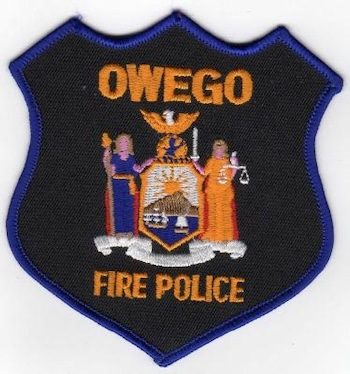
The Owego Fire Police Patch. Photo provided.
As it turned out, though, a hurdle at the state legislative level, “which permitted one fire company for every 1,000 village residents,” would need to be overcome in order to amend the number of Owego’s fire departments, as only six companies were allowable at the time.
Eventually a breakthrough occurred and a plan for the incorporating of the new fire company was laid upon the table but there was one catch that failed to appeal to one existing Owego fire house. According to the April 1, 1909, edition of the Owego Times, “If a new company shall be organized the company will share in the insurance money, which comes to the department. This money is now divided into six parts.
“If a new company is organized, it would have to be divided into seven parts.”
On account of that required catch, the members of the Defiance Hook and Ladder Company, No. 6, voted unanimously in dis-favor of the new company being organized, thus becoming the defiant ones. As of August of 1909, an agreement had yet to be implemented, and the fate of the much-needed Owego Fire Police hung in the balance.
On Thursday, Aug. 5, 1909, during the fourth and final day of the “Old Home-Coming Celebration,” the crowds were immense in anticipation of the morning’s spectacular Farmer’s Parade. As the parade passed by the Ahwaga House, there were judges to grade each float and to later award those participants who scored the highest. After the award ceremony had ended, the crowds once again roared in excitement while awaiting the start of the 56th Annual Firemen’s Parade and Review.
“All Owego and the vicinity turned out and whooped it up for the firemen and again marveled at the skill of the marchers.” In the Aug. 12 edition of the Owego Times, the editor passed a judgment of his own.
“First came the Fire Police of Waverly, a fine appearing body of men, dressed in the regulation fire policemen’s parade uniform.
“Someday, Owego will wake up to the fact that a local organization of this character will greatly improve the efficiency of the village’s fire department,” and eventually, they did.
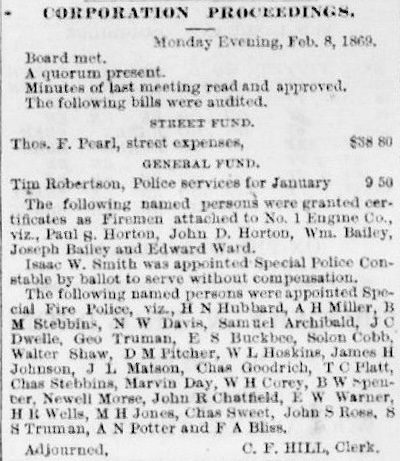
Feb, 11, 1869, Owego Gazette. Provided.
The disparities and dissatisfaction of the volunteer firefighters who favored a well-oiled and efficient fire department, all came to a head on the evening of May 17, 1921. During the Annual Nominating Convention of the Owego Fire Department in the parlor room of the Susquehanna Hose Company No. 1 at the Central Fire Station, it was business as usual until it was time for the delegates to speak their minds.
As reported in the May 19, 1921, edition of the Owego Gazette, “The delegates, understanding that drastic action must be taken if the old-time efficiency of the department is to be maintained, stood up squarely on their feet and talked from the chest.”
The consensus amongst the volunteer ranks was that the once proud reputation of the department had been souring for the past several months. The unpleasant truth of the “low estate of the department” had been setting in and it was very unsettling for the firefighters who swore to serve and protect.
Former Chief Engineer Newton W. Adams suggested the systematization of a county-wide firemen’s association, such as the Tri-village firefighters organization comprising the departments from Athens, Sayre, and Waverly. It was an idea that was supported by a majority of the senior members of the department, but would it be enough to sway the opinions of the village board of trustees, who considered the Owego “Fire Department “at its lowest ebb in its history?”
Another former Chief Engineer, Stuart W. Smyth suggested that “no department officer should be allowed to do any actual fire fighting himself.” He said he greatly admired the spirit of the fellow who liked to ‘eat smoke,’ but for the sake of efficiency, the man in the ranks should be delegated to do this job. The officers cannot direct the fight unless {they are} in a position to see all that is going on.”
The third firefighter to address the members that night was the Ahwaga Steamer and Hose Company, No. 6 Delegate Roy L. Wiltse. Several weeks prior to that evening he had submitted a request to the officers of the individual Owego fire companies for the names of six individuals from each unit who could be reassigned as recruits of a newly reorganized brigade of Owego Fire Police. As of that evening, the only company who had followed through as instructed was Wiltse’s own. Some five months later, it was announced that 36 Owego volunteer firemen were prepared to swear an oath in support of their community and fellow firehouse brothers.
The Owego Gazette, on Oct. 13, 1921, stated, “Each company in the department will be represented by six members in this body, whose members will have all the powers of Special Police Officers. Fire police, however, will not exercise these powers except at fires. It will be the duty of the members of this organization to protect property owners from theft during fires and to establish and enforce regulations that will facilitate the work of the firemen.”
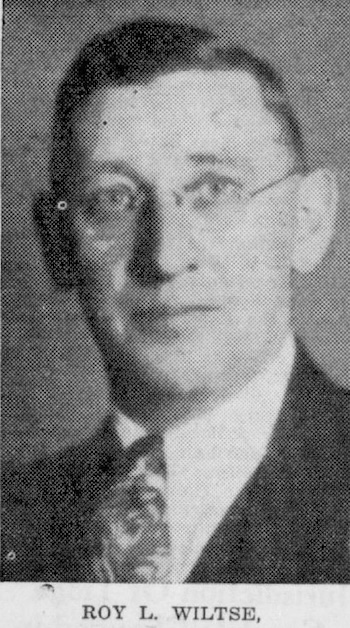
Roy L. Wiltse, Owego Times, Dec. 20, 1938. Provided.
Prior to the village trustees’ meeting on Oct. 17 a gathering was held at the Central Fire Station with all of the prospective appointees in attendance for some last-minute instructions from Chief Engineer Henry J. Briggs. Shortly thereafter, the soon to be-appointed ones appeared in the presence of the village trustees, where Briggs suggested the fire police be appointed special officers to serve without pay, a suggestion that the village leaders immediately adopted, with the swearing-in of each present member then taking place.
“The organization of a force of fire police meets a long-felt need in this village. The proposal to organize such a force has frequently been discussed and recommended by fire department officers, but no action resulted until Mr. Briggs took the matter in hand.”
Meetings of preparedness continued throughout the end of the year and into the new as the men worked towards perfection in every aspect of their duties. A meeting was scheduled for Jan. 20, 1922, in the parlor of the Hiawatha Chemical Company, No. 4, and every Fire Police member was required to attend as some had yet to be sworn in and so a notary would be present, in order to accommodate those who had yet to take their oath before they could receive their Fire Police badges.
By all appearances, the Owego Fire Police were required to reorganize every two years, and on Sept. 16, 1924, the Owego Times ran an announcement that “All Owego Fire Police are requested to return their badges to Fire Chief Roy L. Wiltse as promptly as possible when their term of service will be automatically cancelled.”
On Monday, Oct. 6, the Chief Engineer submitted his reorganization report to the village board, along with a list of 25 new appointees and a handful of holdovers who were on the ballot to be duly elected. The village clerk was then directed to purchase 25 new Fire Police badges, for a whopping total cost of $18.86.
A story that ran in the July 22, 1926, edition of the Owego Gazette cast light on the struggles that the Owego firefighters faced when motorists failed to heed the existing ordinances for a swift department response to the scene of a fire.
The headline read, “The Fire Police Are to Enforce the Village Ordinance Relative to Motorists Racing to Fires with the Fire Apparatus,” meaning in accompaniment of. With all cases and in some ways just as it is today, the penalty for obstructing the ability of the Owego Fire Department to respond swiftly to a fire-involved emergency was rather costly to an offender for impeding the ordinance of “move over.”
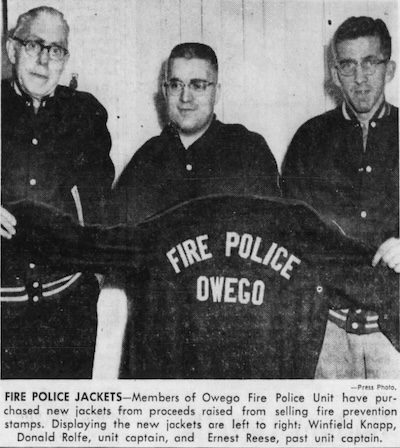
Fire Police, Feb, 2, 1964, Press & Sun Bulletin. Provided.
One portion read that “The vehicles or apparatus of the fire department, of the street department, and ambulances shall have the right of way in any street and at all times” within the village. Also, the hindering of a firefighter’s ability to conquer the flames, the rescue of any victims, and the propelling of any vehicle less than 100 feet from all emergency apparatus, and “upon or over any fire hose in use,” was forbidden as well.
It was also against the law to breach all boundaries as established by second assistant engineer Frank W. Bell who had charge of the fire police. “Any person violating this ordinance or any of the provisions thereof shall be liable to a penalty not exceeding twenty dollars for each such offense,” which is equivalent to nearly $350 in the year 2025. Under the New York Penal Law nowadays, the sentence for a person’s obstruction of firefighting operations is punishable by a fine of $1,000, up to one year of incarceration, or both.
The officers of the Owego Fire Police in 1926 besides second assistant engineer Bell, were Captain Newton W. Adams, and Lieutenants Frank H. Stever, Andrew J. Franz, Willis C. Kinney, and Louis “Louie” S. Skinner.
Throughout the early to mid-nineteenth century years (1935 / 1964) the Volunteer Owego Fire Police Organization, for the most part, appears to have remained active in the community, though their service appeared to be largely unnewsworthy. From first aid training in 1935, to the “policing of the inside of the arena” during a Wednesday evening fight night at the South Depot Street Arena (a.k.a. Joe Feldy’s Arena) on Aug. 28, 1935, where approximately 3,000 fans had attended. The Fire Police were responsible for making sure that each ticket holder was seated where he or she had been numerically assigned. The main bout of the night, between Joseph Ketchum of Johnson City and Carl S. DelBerta, a professional boxer from Oneonta, lasted nearly five complete rounds before Ketchum gained the upper hand and was declared the victor.
On Oct. 20, 1948, Binghamton’s Press & Sun-Bulletin ran an announcement that during Owego’s Oct 18 village board meeting, it was decided that the Fire Police should be reorganized yet again, possibly meaning that for a period of time the unit had been defunct. Eleven names of firemen from the village’s six departments were approved by the trustees.
“These men will comprise the fire police and will work directly under the Owego Police Department during fires,” with duties ranging from directing traffic to controlling the crowds; but unlike back in 1871, any incarcerations in 1948 were to be left in the hands of the OPD officers.
“The new group will begin its duties as soon as a class of instruction, in charge of a member of the police department, has been completed.” Right around the beginning of 1954, the chartered “Volunteer Fire Police Association of the State of New York” organization was established. The still-existing non-profit organization provides training and raises awareness about the importance of a fire policeman’s role in contributing during a fire or other emergency situations.
In 1960, there was a weekly column in the Owego Gazette titled “The Sparrow Chirps.” The anonymous local columnist usually focused on the vicinity’s high school sports action, but on Sept. 14, 1960, the elusive writer changed the subject. In the Owego Times on Sept. 9, a deplorable headline shrieked, “TWISTED STEEL-MANGLED BODIES” which ruffled the feathers of “The Sparrow.”
The Owego Fire Police unit had been instructed to keep the gawkers at bay, but the pushback appears to have been more than they could handle. The “Sparrow” squawked about a “Man that fights for a good position to see how mangled the body is.”
Even though the Fire Police were able to resist most of the sightseers, a small clique of persistent oglers were able to push by. The police on the scene had their hands full with directing traffic, so the Fire Police gave it their all and performed their duties as well as they could.
The “Sparrow” went on to state, “The State Police were so gratified with the work of the Fire Police last week that they presented the newest agency of the Owego Fire Department with a case of flares.”
Another case of gratification toward the members of the local Fire Police was highlighted in the March 23, 1960, edition of the Owego Gazette, announcing that the village board of trustees had “approved the payment of $6 for hot coffee and doughnuts served {to the} Owego Fire Police while they were on duty at Dead Man’s Curve for several hours recently after a huge bridge girder overturned in the street while en route through the village.”
Throughout the latter decades of the 20th century and well into the 21st, the members of the Owego Fire Police have continued to faithfully serve this community. Presently there are approximately 15 volunteer fire police within the ranks of the OFD. Feb. 8, 2025, marked what would have been the 156th anniversary of the Owego Fire Police unit, if it had been consecutively active as a village-appointed unit.
I have a feeling that Joseph “Old Joe” S. DeWitt would be very proud of what started out as his “Exempt Fire Police” and what an exemplary organization it has become. The Owego Fire Police and the Owego Fire Department are continually in need of volunteers. If you are interested in joining either, you can download an application at Owegofire.org, and, as always, the OFD and the OFP thank you for your support and your gratitude for their service to our community.

Be the first to comment on "The Owego Fire Police; 156 Years in the Making"