
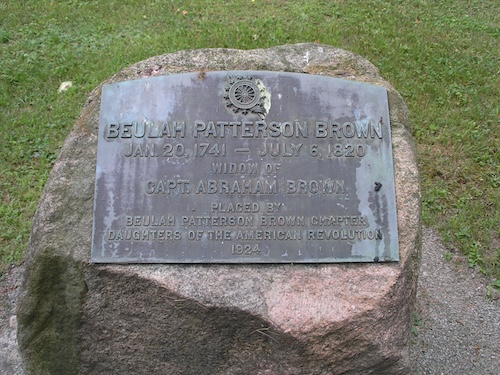
For many years, Marty Schneider has created a historical display for the Ray Shaver Depot in Newark Valley to be viewed as people enjoy music, food, and camaraderie during the Depot Friday Night music series, an event that runs every Friday through August starting at 7 p.m. August programs begin at 6:30.
This year, of course, being the Semiquincentennial or the 250th of the nation’s beginning, the focus is on the Revolutionary War. She researched local, print, and a variety of Internet resources to cover the contributions of 32 individuals who played some part in the Revolutionary War and how their lives evolved once they settled in Newark Valley. (The task became much more challenging because at first she thought there were only 11.)
Besides the time spent during the 1776 to 1781 war, she documented when these individuals arrived in the area, named their spouses, where they settled, what they accomplished, and where one can find their graves.
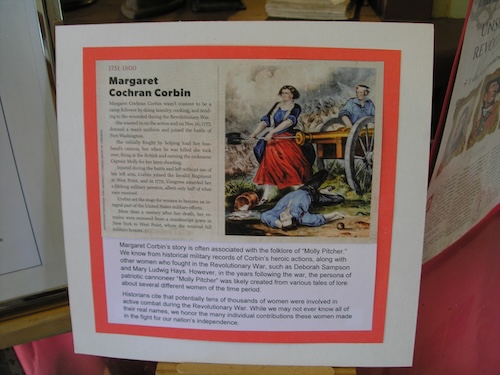
Photo provided.
Many of these individuals have progeny who still dwell in these environs. Some of those profiled include the following: Reuben Legg, Asa Leonard, Josiah Ball, Lt. David Pixley, Asa Bement, Jr., Elijah Walter, Capt. Ezra Whittlesey, Amos Patterson, Capt. Bill Torrey, Dr. Joseph Waldo, Joseph Hosford, and Caleb Gleason.
Individual sketches can be quite illuminating and fascinating. Josiah Ball was an early settler in Brown Settlement. He was a cobbler and taught school in his shop.
Lt. David Pixley was fluent in a local Indigenous language, which made him very valuable in negotiating land sales.
Although Asa Bement Jr. was only 12 in 1776, by age 16 he would be obligated to be part of the Massachusetts Militia. Asa, of course, came first to Newark Valley in 1792 and established a substantial farm, along with a saw mill, a grist mill, and a blacksmith shop.
Dr. Joseph Waldo came to Berkshire in 1800 and for many years he was the only doctor north of Owego.
Samuel Osborne ran away from home at age 16 to join the rebel cause and settled in Jenksville.
Joseph Hosford was a drummer for the Clinton-Sullivan campaign.
Caleb Gleason, who had skills in both the fife and the drum, also had 21 progeny with his three wives.
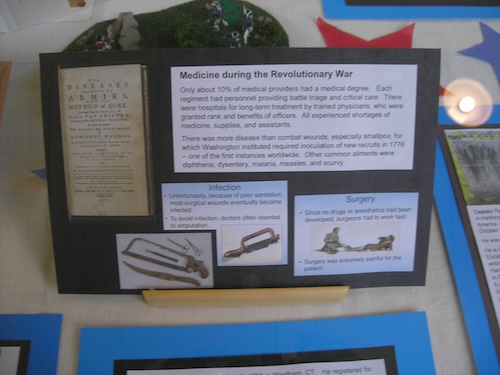
Photo provided.
The presentation also includes a Timeline of the Revolution, the major campaigns and battles, along with others not as well known, such as the Battle of Bennington and the Battle of Morrisania. There is also information on general topics such as the Sons of Liberty, the Militia and Minutemen, typical rations for soldiers, medical practices, and the role of fifers and drummers. Another display shows how the nation’s flag has evolved over the years.
Marcia Kiechle, Director of the Ray Shaver Depot, solicited essays about democracy and the nation’s founding from a number of adults. There were seven people who responded, and these can be read on easels. The 5th and 6th graders from the Newark Valley Middle School also contributed a wide variety of writing. The 5th graders had just returned from their Washington, DC trip and used their experiences for their writing efforts, along with some kind of illustration. Middle School teacher Kirstie Hardenstein deserves much credit for this.
The 6th graders did research on the topic of American history and documented their work.
The Depot is open at 6 p.m. every Friday through the end of August. If any group is interested in seeing the display at another time, this can be arranged for a donation to the Society. Please call the office if you are interested at (607) 642-9516.

Be the first to comment on "Revolutionary War Display Presented Through the Newark Valley Historical Society"