
Q: Greg, I might have owned one of the rarest cars out there!
Here’s the story.
Back in 1970, the owner of Pell Pontiac/GMC in Westborough, Mass. ordered this car for himself to keep the insurance costs down and offer the same power of a GTO.
Pell ordered a black 1970 Pontiac Tempest 2-door with optional GTO Judge stripes along the side. Other than these fender stripes and an all black and very dull “taxi cab like” interior, it didn’t qualify in the “looks” department as a potent muscle car.
However, Pell knew what to do on his order form. His “sleeper” came with the optional 400 cubic-inch V8 with a Muncie 4-speed peeking up from the bench seat. It did have the hood-mounted tachometer and on the bottom of each fender sat a 400 emblem. It also had an optional black vinyl top.
I know it had either a low gear (high numerically) like a 4:10 ratio as it was real fast off the line but not much of a top end as the RPMs would get up there quickly.
So, what do you think? Are there any records of this car anywhere? It never had a T-37 badge, so I know it was not one of those.
I paid just $760 for the car, as it was the era of the gas crisis and that is all the person I bought it from could get on a trade-in. It only had 16,000 miles on it.
I live in Cotuit, Massachusetts, on Cape Cod, and used to see your columns in the Cape Cod Times. I still dream of that Pontiac and what might have been. Also, it never had a T-37 badge on it, just the 400-engine badge on each side fender. Wish I had the VIN to my Tempest, but I don’t. Thanks a lot, Ken Kulduff, Cape Cod, Mass.
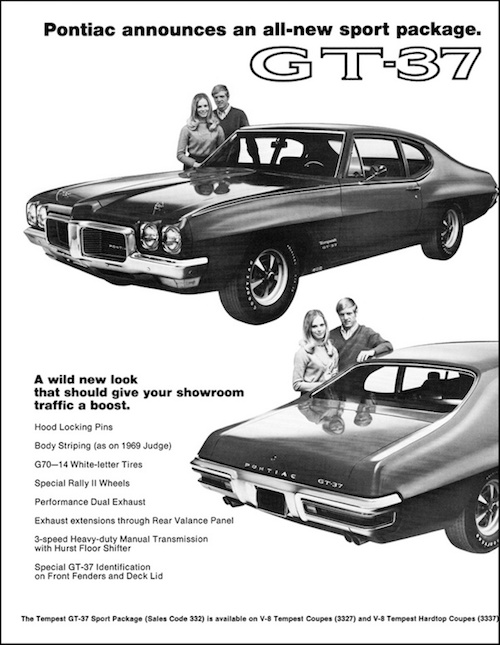
Advertisement for the powerful 1970 Pontiac GT-37, which were stripped down GTOs with optional Ram Air III GTO engines. (Pontiac)
A: Ken – thanks for all your emails helping to put this column together. Since you don’t have the Vehicle Identification Number (VIN), we can’t be 100-percent sure it is a “one of one only” Pontiac. However, at least we both can agree that you indeed did own an extremely rare muscle car ordered by the person who owned the Pontiac dealership himself.
Order wise, all GM dealers had the opportunity back then to put together a uniquely equipped car and then have it filed under what was called a “preferred order” status. This is not to be confused with COPO (central office production order) high performance cars, like the many COPO Camaros ordered in the past and present.
Let’s get to your questions by first explaining to our readers what you meant when you said it didn’t have a “T-37” badge.
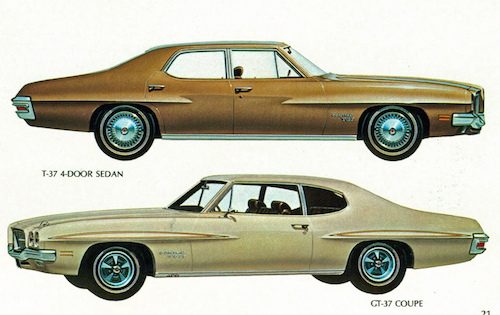
Things changed a bit in 1971 as Pontiac used the longer Lemans frame instead of the previous Tempest series in 1970. Even a four-door was offered, but nowhere near as popular as the 2-door hardtops. (Pontiac)
Pontiac released a T-37 and GT-37 model in 1970 and 1971. The T-37 was a Pontiac A-body trim midsize car that was a stripped down, low priced, Tempest. Meanwhile, and even though the GT-37 had the Ram Air III engine, no ram air hood was available and just 1,419 GT-37 coupes were built in 1970. A note here is that the GT option cost $236.97 and included Judge style accent stripes, Rally II wheels minus the trim rings, white letter tires, dual exhaust, 3-speed manual floor-mounted shifter, remote mirrors, hood pins, and the GT-37 nameplate.
This 1970 GT option was solely for exterior sprucing up and did not include any additional performance engine options. Thus, the GT-37 was the performance alternative to the T-37 and any Pontiac V8 could be ordered from mild (255 horses) to wild (the Ram Air III at underrated 345 horses).
Both the GT-37 and the T-37 were produced just these two years; early T-37’s were limited to what you could order in 1970. In 1971 the GT-37 could be ordered with a 455 H.O. V8 engine. The transmissions still included the legendary M22 Muncie 4-speed “rock crusher” and up to 4:33 rear gears. Non-GT models were still known as the T-37 in its final year and still a stripped Pontiac Tempest / Lemans model that came with a cloth bench seat and rubber floor mats, which is what Pell 400 Pontiac ordered. I also think your “400” might have had the 4:33 gears instead of a 4:10 as nine different gear ratios were available, but no 4:10 or 4:11.
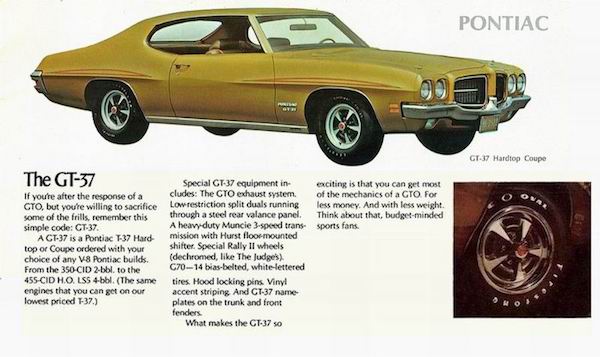
Although the Pell Pontiac 400 was in reality a GT-37 hi performance muscle car, the dealer ordered car was “piece mealed” together and had no GT-37 badges. (Pontiac)
Built intentionally to offset any insurance company high premiums, your Pell 1970 400 is similar to the GT-37 that year and is a prime example of muscle car camouflage. Interesting is that the GTO Judge was also promoted as a stripped down version of the “regular” GTO, although nowhere near the “37” series in being insurance quote desirable.
Pontiac’s T-37 arrived mid-year 1970 as the muscle car revolution was just starting to slow down due to very high muscle car insurance premiums and the coming gas crisis. Thus, if you wanted a GTO, the insurance premiums were sky-high if teenagers or under 30 years of age drivers were on the policies. So Pontiac instead used VIN numbers from the non-performance Tempest coupled with 37 series model identification to fall under Pontiac Tempest insurance rates, which were way lower than a GTO/Judge.
As for nomenclature, “T” stood for Tempest and “37” was the Pontiac internal code for any and all hardtop coupes across the line.
The initial ‘70 Pontiac GT-37 was the most powerful Pontiac muscle car produced when equipped with the Ram Air III 400-inch engine that put out a conservative 345 horses, which Pell made sure he ordered as this 400 Ram Air was the hot ticket.
However, in 1971 things changed. The Tempest was no longer available, so Pontiac used its identical 112-inch Lemans chassis for the T-37 models and its corresponding lower insurance premiums. Further, the 1971 models were 100 pounds lighter than the two-door models. A four-door T-37 was also available, but its wheelbase was four inches longer and not suited for muscle car enthusiasts.
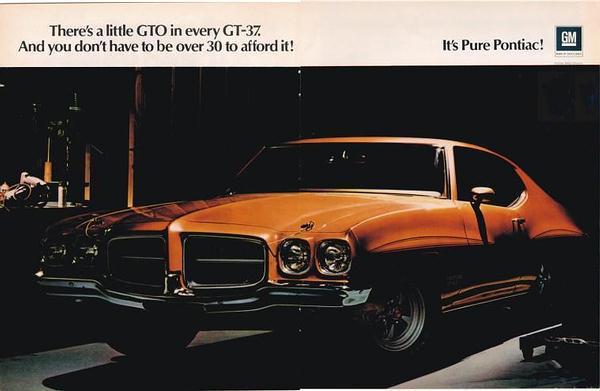
The GT option for ’71 included a Hurst shifter and again any GTO style engine could be ordered. As for marketing, Pontiac even utilized the saying “There’s a little GTO in every GT-37, and you don’t have to be over 30 to afford it,” clearly in reference to the high under 30 year-old driver insurance rates for the GTO.
The most powerful engine option was the $358 H.O. 455, rated at just 335 horses thanks to lower compression ratios and unleaded gas. Overall T37 production came in at nearly 36,000, of which 5,802 were V8s. But of the V8s, only 54 had the 455 H.O. engine, making the 455 powered GT-37 the rarest of all. In comparison, the Ram Air III was the better and quicker of the two and was the engine in your 1970 Pontiac 400.
You mention you had a Muncie 4-speed, which came in M21 (wide ratio) and M22 “rock crusher” (close ratio) format. The M22s, which had a nice whine to it and were the best of the GM four-speeds at the time. They stood up to speed shifting better than any other resulting in its “rock crusher” slang. I had one in my ’68 Camaro SS/RS L78 396/375 and it held up well under my relentless speed shifting.
In summary, few high performance 37s are around these days and as for your “Pell 400” Pontiac, I would bet it just might be a “one of one” classic. If you ever track down that VIN, please share it with me.
Thanks much for the communication, and I, too, dream of driving my ’68 Camaro or ’67 GTX regularly.
(Greg Zyla is a syndicated auto columnist who welcomes reader input on collector cars, auto nostalgia and motorsports at greg@gregzyla.com.)

https://www.facebook.com/photo?fbid=4068941523430697&set=pcb.1838187420251245
https://www.facebook.com/photo?fbid=4068941523430697&set=pcb.1838187420251245