
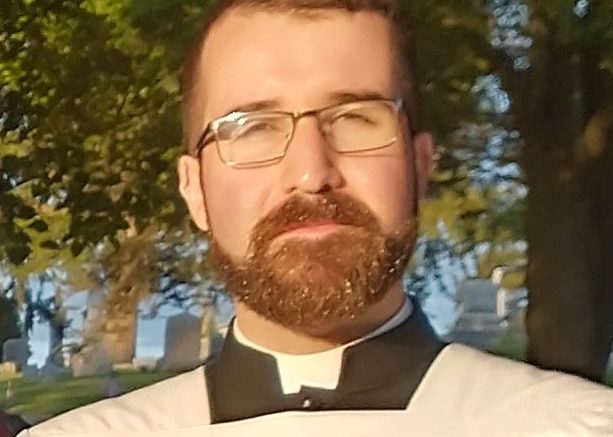
[By Fr. Jim Muscatella, Parochial Vicar, Blessed Trinity and St. Patrick’s Parishes]
It’s 11:15, Sunday morning in Rochester, New York, at St. Stanislaus Kostka Parish, Polish Mass has begun. The organ is churning, the people are chanting, and American children call out to their bilingual parents in a lovingly preserved mother tongue – it is all very beautiful, and it is all very Polish.
The priest, however, is not.
That priest is me. Italian-American as chicken parm in marinara, Fr. Jim Muscatella.
Fr. Roman, their pastor, was born, raised, and ordained in Wroclaw, Poland. After 19 years in America, he still calls out to me with a spirited “Dzień dobry,” meaning “good morning.”
Then there’s me. With a Calabrese crescendo of vowels, my last name begs to be sung like a Sicilian folk tune – you can almost smell the sweet vino as you enunciate the double “L.”
You can’t give what you don’t have, so I preached to those pious polacchi from what I had: the Italian words of my grandmother.
“Mangia fa’ gras’” was Mary Muscatella’s sure conclusion to any prayer before supper, sung out with a smile and a laugh – “Eat, and get fat!”
“Testadudo,” was the name for anyone who would think of refusing such a kind invitation – “hard-head.”
And then there is a family favorite – “Stonat’! (stew-KNOT)!” The men of the family, calling out to virtually any other driver on the road, offered it as a stand-in for “stupid,” or “stubborn.”
Truthfully, it is not. Instead, “stonat’” has the colorfully musical connotation of being “out-of-tune.” For a delightfully dramatic race like mine, pathologically operatic in both speech and deed, this is a most cutting critique.
And so I preached – how the hard bump of Adam and Eve’s Fall had left us all a bit testadudo – and when the hardness of a broken world had left us all wearied and worn-thin, Christ came a calling – Mangia fa’ Gras’; take and eat; receive the gift of grace; be made whole by the God Who gives Himself for you.
Hear His call – don’t be Stonat’.
And so, we all prayed – English, Italian, and Polish together.
Be careful what you preach.
In the hall afterwards, I found the children fixed in attention – handling hot wax and hollow eggs. This was proper egg decoration, the Polish way. My altar servers called me over as they sketched sacred designs over the white shells – soon to be dipped in a series of pastel dyes; come Easter morning, these were to be delightful displays of their culture and devotion.
One of their fathers turned to me: “Father, will you decorate an egg?” As I began to refuse the offer and excuse myself, I saw that smiling Slavic face take on an almost Sicilian smirk; I heard these words, now preached to me: “Don’t be Stonat’!”
And so, the priest sat with his people, and the Italian made a Polish egg. He entered into their joy, instead of scurrying off to whatever he thought he might be doing – and he was so much the better for it.
Sin is a sadness because it makes us all stonat’. The same God who called all of creation into being, and from the first called every part of it “good,” has never stopped calling out to us – with cheer and generosity.
Christ calls to us behind the screen of every confessional, and from the altar at every Holy Mass – He comes to pull us out of the dirges we’ve been deafly crooning without Him; out of the tragedies we’ve trapped ourselves in apart from Him.
Against the dissonance of a fallen world’s despair, which has made us sincerely stonat’, He calls out with the Good News of hope and salvation; to hearts starved in sin and suffering, He beckons as if to say, “I am your salvation – this is my Body, given up for you! Take and eat! Mangia fa’ gras’!”
Holiness is to hear His call. It is to delight in the God Who delights in us, and thus become a wonder to the world as we join His song of salvation. Christ offers the key: will we be stonat’, or make a harmony?

Be the first to comment on "A Pastor’s Thoughts: Don’t be Stonat’ – Mangia fa’ gras’"