
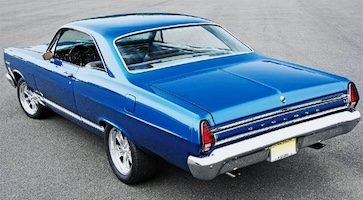
By Greg Zyla —
Q: Greg, I follow your column in the Press Enterprise newspaper out of Bloomsburg, Pa. My question is about an older model of Mercury.
An older brother-in-law had a fancier Mercury sedan from the early to mid-1960s. The rear window slanted toward the front instead of toward the back of the car and the roof line extended past the edge of the rear window. Am I remembering correctly? I also thought the rear window would recede down behind the rear seats. I thought it was the coolest car and wanted him to save it for me! I was just a kid, maybe 10. Am I remembering any of this correctly?
You always seem to know or can find out all sorts of arcane items about cars. Thanks! –Tim Stueve, Elysburg, Pa.
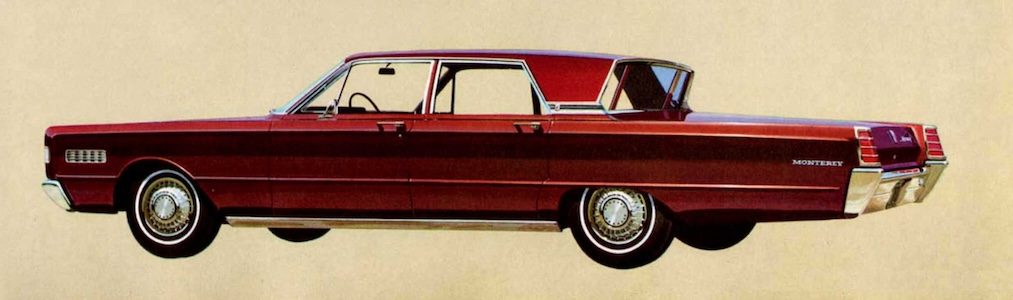
The Mercury Breezeway models were built from 1963 to 1966. The rear window “reverse” design allowed the window to roll down and improve the car’s ventilation. (Mercury)
Tim, you have a good memory, as Mercury indeed offered such a vehicle. The Mercury models with the reverse-slanted, power-operated rear window were known as the Mercury Breezeway models and were available on several Mercury models. Breezeway options were offered with the full-size sedans in the Monterey, Montclair, S-55, and Park Lane models from 1963 to 1966.
The Breezeway window was designed to improve ventilation by allowing air to flow through the car. As a division of the Ford Motor Company, Mercury sold millions of vehicles over its production years from 1938 to 2010. However, tracking down info and specific sales figures took longer than it did to write this column. Individual features about the Breezeway window are hard to pinpoint, as Ford didn’t even offer production numbers on engines and transmissions. Thus, you don’t see many numbers matching early 1960s Ford and Mercury collectibles at Mecum and Barrett-Jackson auctions.
Mercury Breezeway models were indeed unique “window trim” cars during that era, but exact sales numbers for those specific models aren’t correct as many of my books have different numbers.
However, I did better while tracking down pricing, as most of the 1963 Monterey Custom and Montclair models averaged in the neighborhood of $3,200, although the S-55 Breezeway came with a base price of $3,650 to $3,715. The S-55 was the performance version, arriving with either the standard 390-V8 or the optional 406 and 427.
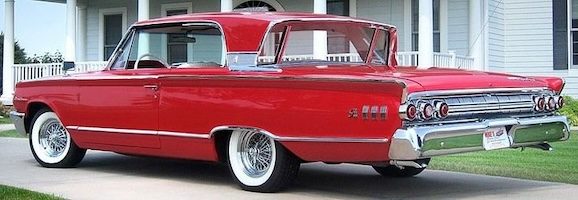
Advertising highlighted the Mercury unique design, including a high-performance S-55 model that featured either two or four-door designs and engines including a standard 390 V8 or optional 406 and 427 engines. Transmissions were automatic or floor mounted 4-speeds. (Mercury)
The 427 cubic inch V8 engine option for the 1963 Mercury S-55 was a significant upgrade, but specific pricing details for this option alone are not readily available.
The Park Lane Breezeway arrived in 1964 and was the most expensive, starting at $3,867, while a convertible Park Lane model started at $4,118.
The Mercury Breezeway models were discontinued after the 1966 model year. There were a few reasons for this decision according to Ford. First and foremost were declining sales. When introduced in 1963, Breezeway models experienced positive sales with some 92,000 units sold. Unfortunately, by 1965 sales dropped to just 46,000 Breezeways.
As the muscle car era began, baby boomer sales concentrated on intermediates and performance, making the full-size Breezeway models less interesting. Popular now were the Mustangs, Comets, Cougars, and Fairlanes, some with 390 and 427 engines under the hood. Thus, the older consumers also progressed to the popular intermediates, be it a six-cylinder or a muscle car engine under the hood. This move away from the large cars resulted in the ending of the Breezeway availability.
The Breezeway’s retractable rear window was designed to improve ventilation, yet in the end, there were better ways.
As for firsthand experiences, my uncle John, who worked for Mercury at its Edison, N.J. assembly plant, bought a brand new 1964 Mercury Breezeway, which I think was a Montclair. He then stayed a full-size Mercury fan, owning five more big Mercury’s that I remember before he passed in early 2000.
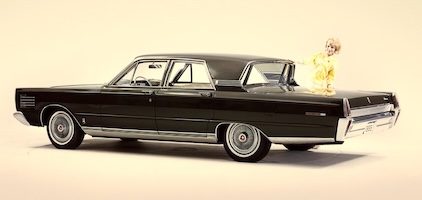
The high-end Park Lane arrived in 1964 and was the most expensive Breezewood available. It also offered a 425 horsepower 427 as an option. Shown is the 1965 model in an elegant black finish. (Mercury)
Of all the Mercury’s ever produced, I feel the most popular was the Grand Marquis series, built on the Lincoln Town Car platform and one of Ford’s most reliable cars ever built. The Grand Marquis was built 36 years, from 1975 to 2011. The final Mercury vehicle, a Grand Marquis, rolled off the assembly line in January 2011. This marked the end of the brand’s 72-year history.
Hope this answers your questions on the Breezeway Mercury and thanks much for your letter and exceedingly kind words.
(Greg Zyla is a syndicated auto columnist who welcomes reader comments or questions on collector cars, auto nostalgia or motorsports at greg@gregzyla.com or snail mail to Greg Zyla, Roosevelt St., Sayre, Pa.)

Be the first to comment on "Collector Car Corner/Cars We Remember; Mercury memories, even a ‘backward’ design"