
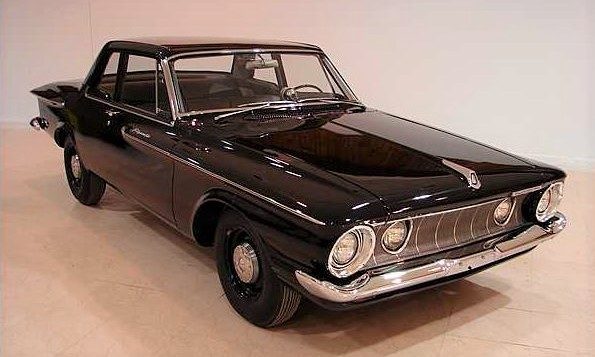
I’ve finally compiled my list of Top Muscle Cars of All Time, although I’m changing the plan. It is taking much longer to put together than expected, so instead of just giving a list of the Top 10 overall, I will present them in full column format because I couldn’t give just due to these cars in quick paragraph or two.
Thus, this is the first installation of what will be 10 columns on the “real” muscle cars that are not limited to a particular decade. Additionally, don’t look for 10 columns in a row as I’m still touching up my second installment and it should be finished in a few weeks.

The engine that powered both Plymouth and Dodge featured 413 cubic inches and 410 and 420 horsepower versions thanks to 11.1 and 13.5 compression ratios, respectively. Fuel was fed thanks to dual Carter four barrels on the cross ram design intakes. (Dodge)
The muscle cars I selected include the cars that made history either on the racetrack or on the street (preferably both), with special attention given to the factory intentions of building cars that were muscle car specific or surprised everyone on the race track.
So, here we go with the first of 10 all-time great muscle cars.
1962 Plymouth Savoy / Dodge Dart 413 Max Wedge
High atop my list of real muscle cars sits this 1962 effort by Chrysler Corporation. Not only were these Savoys and Darts built for drag racing, they came with factory designed cast iron exhausts that were almost as good as a set of fender well headers. The factory exhaust included an “open/close” removable plug that the owner could unhook for instant free flow exhaust advantages.

The front end of the ’62 Dodge Dart featured a protruding inner grille with round headlights that took some time to get used to. Even without the high performance engines, these ’62 Darts weren’t the most popular with consumers. Today they are sought after collector prizes. (Mecum Auctions)
Among the leaders of the upcoming 1960s Detroit high performance boom, the 413 wedge V8s were capable of running low 13-second quarter miles right off the showroom floor. Personally, I had access to a race-ready ’62 Savoy 413 named “The Jolly Roger,” which sat across the street from my parent’s house on Arcadia Place in Vineland, N.J. At 13 years of age I would go over to that house whenever the Jolly Roger appeared just to be next to it and then see it run in the high 12-second range at the drag races Saturday nights.
Extremely popular with drag racers and street cruising enthusiasts, a few of the muscle car specifics of these MOPAR muscle cars included a unique cross-ram dual-quad intake manifold that boosted torque and horsepower by using long runners that assisted the quickened the air and fuel ratio to the engine. Two 413 engines were available, both featuring high-compression ratios of 11:1 or 13.5:1 and required premium gas for top horsepower production. These 413s with 480 lb. ft. of torque were faster than the showroom stock ’62 409 Chevy and horsepower ratings were set at 410 for the 11.1-compression version and 420 for the Max Wedge 13.5-compression model.
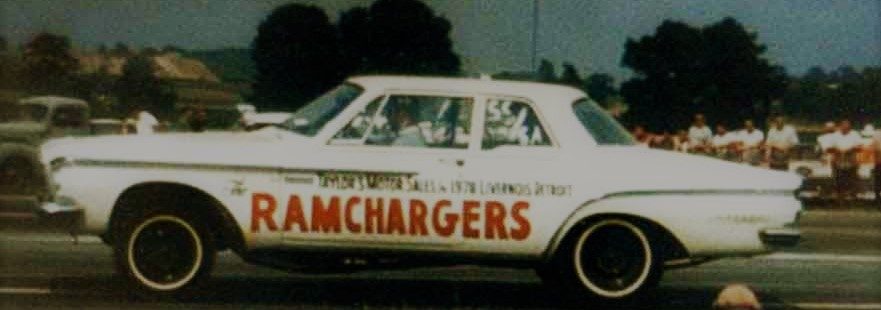
The respected “Ramchargers” utilized the Dodge brand to race into drag racing immortality thanks to its members all being engineers for the Dodge division. Their 1963 Dart would feature Candy apple red stripes on the top and trunk and became a “Ramchargers” trademark. (Dodge)
Also important was the Savoy/Dart lightweight build properties. A new unibody construction reduced weight versus the previous body-on-frame design. Instantly the 1962s were better handling cars versus the previous year examples. These MOPARS also featured an enhanced suspension and heavy duty drum brakes all around that bettered stopping distance by a bit. From a personal experience with my ’67 GTX, these drum brakes were at best just “so-so” stopping after a quarter-mile run with limited shut down areas.
As for looks, although the “in your face” Dodge Dart front end grew on me, the Plymouth Savoy was the better looking of the siblings. The styling and interior were more of an afterthought and all business in a no-nonsense style. However, thanks to the powerful 413 engines under the hood, you were king of the street if you happened to own one. Back then you had two transmission choices, either a heavy duty floor mounted 3-speed manual or the more popular TorqueFlite automatic, the latter that you shifted with push buttons on the left side of the dash.
Noteworthy is Chrysler figuring out how to get the automatics to launch with authority, which they accomplished thanks to using the smaller 9-inch converters, used on the Slant-6 line of cars. The converters were beefed up of course to handle the Max Wedge 413 power, but prior experiments even included “banzai” high RPM neutral to first experiments that blew up the TorqueFlite transmissions. The 426 Hemi “main engineer” and “Father of the HEMI” Tom Hoover told me that personally at Beaver Springs Dragway a few years before his passing on April 30, 2015 at the age of 85. Hoover also worked on the Max Wedge efforts, too.

The interior of the 1962 Savoy and Dart were void of any real comfort features and the automatic transmission shifted via the pushbuttons along the left side of the instrument panel. (Plymouth)
The 1962 413 MOPARS weren’t cheap by any means and less than 500 were ever built. The high price tag of near $3,500 put them out of reach of many buyers and was near twice the price of a Slant-6 powered Savoy. Yours truly owned a black ’62 Savoy in 1969 and used as my runaround car. Further, if you were cruising the avenue back then, the extremely low fuel economy of the 413 made them highly impractical for daily driving.
How much MPG did they get?
The 413 Max Wedge delivered 8-city and 12-highway, similar to the 409 Chevys and 406 Fords of the day. This economy reality, even coupled with 30-cent per gallon fuel, made some of us find large parking lots where we parked our beloved muscle cars to give them a low-speed break (our plugs fouled out pretty quick driving 30-MPH). It was at these parking lots or drive-in burger stands where street racing “call outs” were the norm and the bigger street race events that drew big crowds were planned. On any given Saturday night, there would be many races planned and one, big money race included on the card. (All illegal ten as it is now, so please don’t street race).
Further, the 413 Max Wedge engines back in 1962 were available in any Plymouth Savoy or Dodge Dart model, regardless of trim level or body style. This means if you needed a station wagon that could beat a 409 Impala, Chrysler could deliver a Max Wedge wagon sleeper.
In summary, the 1962 Plymouth Savoys and Dodge Darts with the 413 Max Wedge engines were way ahead of the competition as to what would become the biggest and most exciting time in the history of the American muscle car; and things were just getting started.
(Greg Zyla is a syndicated auto columnist. He welcomes reader questions and comments on collector cars, auto nostalgia and motorsports at greg@gregzyla.com.)

Be the first to comment on "Collector Car / Cars We Remember; Top muscle cars of all-time: 1962 Plymouth/Dodge 413 Max Wedge"