
Jean Koski
For The Pennysaver
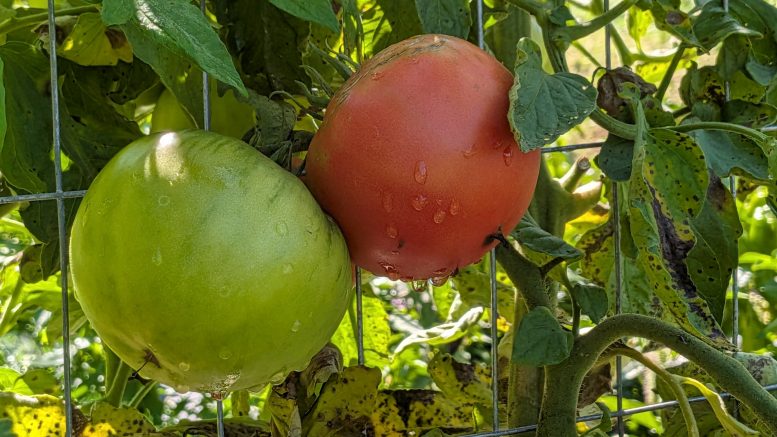
With harvest season well under way, the focus of many gardeners’ efforts is quickly turning towards tomatoes. For this particular gardener, tomatoes are a loved staple. Setting up an outdoor kitchen for crafting tomato-based sauces has become an annual tradition that I look forward to even in the dead of winter as I am perusing seed catalogues, searching for inspiration for the next growing season.
Imagine my dismay years ago as I watched a promising, abundant crop of tomatoes melt in a matter of days under the ravages of late blight, (the same pathogen that caused the Irish potato famine in the 1840s).
The disease had come into the area early in the season on infected nursery transplants and had no trouble quickly spreading to nearly everyone’s home gardens. No tomatoes for me that year. A lesson I do not care to repeat and so I chose to learn from the experience, adjusted my practices and moved into the next growing season better prepared to deal with the most commonly encountered challenges to the home-grown tomato enthusiast.
Tomatoes face a number of challenges. Many of us are likely seeing manifestation of disease, nutritional imbalances, insect and critter damage in our gardens right now. I know I am! Those I encounter most often are blossom end rot, Septoria leaf spot, mildews, voles, slugs, early and late blight, and sun scald.
Sound bleak? While yes, it can be a challenge to grow the perfectly pretty summer slicer brimming with sun ripened flavor, do not despair! It is possible to navigate each one of these challenges organically by making wise choices and using good horticultural practices. There are some basic good garden keeping skills that are universal such as appropriate site placement, crop rotation, soil health maintenance, and managing the sun/water/growth balance. In the case of tomatoes, key considerations, techniques and skills make a huge difference in ensuring a reasonably successful crop year after year.
After my experience with late blight, I seek out seeds for tomato varieties that have at least a moderate ability to withstand late blight. In fact, I often find varieties equipped to withstand the pressures of multiple diseases. While I grow a variety of tomatoes including roma-types and heirlooms, the bulk of my crop are hybrid varieties that have been chosen for their disease resistance abilities. This allows me to be reasonably confident that the plants will have a good chance of out-growing several different diseases without chemical intervention.
Another important practice for disease control is to maintain good potential for air flow and sun
penetration around plants and within the canopy. Many tomato “plagues” thrive in those damp shady places of an overgrown space. It often is also where you would find a clustering of insect pests.
Tomatoes lying on the ground are easy food for slugs, voles, mice etc. Giving plants adequate growing space, trellising or caging, keeping weeds at bay and selective pruning are all important. Key principles of selective pruning for tomatoes are to remove excessive suckers, and anything that appears yellowing or diseased, while maintaining adequate leaf area for good photosynthesis and some shading for developing fruits.
Beyond disease and pest issues, malformations can have a number of causes. Two of the more common are blossom end rot and sun scald. Sun scald is just what it sounds like. While tomato plants are sun lovers, the fruit can suffer with direct sun beating on it for too long. Especially in years when summer is dry, hot and sunny, you would want to be sure you aren’t overdoing it with the pruning, whereas in a wetter season, opening up the canopy may mean the difference between moderate mildew or full blown fuzzy white plants.
Tomatoes benefit greatly from good moisture management. Proper moisture is important in helping minimize sun scald symptoms, and it is crucial to the control of blossom end rot. Blossom end rot is a symptom of calcium deficiency. Plum and Roma varieties tend to be more prone, but it can afflict any tomato. In most cases, the problem is not that there is a lack of calcium in the soil, it is more the dissolvability of calcium and how it moves through the plant. Calcium is one of the less mobile nutrients, It is not always easily dissolved. It moves exclusively in water through the xylem and does not relocate within the plant once it stops moving. Thus, if soil gets too dry especially at times when a plant is putting on a lot of growth, or fruit is developing: calcium gets stuck and deficiency symptoms will ensue, often showing up as blossom end rot. To minimize blossom end rot, it is important that plants are not allowed to dry to the point of wilting. Also, it is never good practice to keep soil sopping wet at all times. Most of our common vegetable crops cannot withstand the anaerobic conditions created. You are aiming for as even a balance as possible. Gauging soil moisture and having a relatively easy way to water your plants when needed is crucial to consider in your overall garden design. Lastly, removing any blossom end rot afflicted fruit and keeping up on harvest will help balance the water needs of the plant. For anyone going the organic route, good horticulture is necessary for success. Learning the needs of your plants, understanding the attributes and challenges of your growing space and balancing your care according to the conditions of the growing season may seem complex, but growing is a journey of learning and adjusting. Eventually you find it all can come fairly naturally. The decisions you make and the actions you take all become part of the cycle, improving and growing year after year.
For more information, contact the CCE Tioga Horticulture & Master Gardener program by calling (607) 659-5694 x3 or email us at Tioga@cornell.edu.
Jean Koski is the CCE Tioga Horticulture Educator/Master Gardener Coordinator.

Be the first to comment on "Tomato tips for home scale gardens"