
[By Wendy Post]
According to a report from Thomas P. DiNapoli, New York State’s comptroller, New York farmers face increasing economic and financial pressure due to federal policy changes, including higher tariffs, cuts to certain agricultural programs, and stricter immigration enforcement policies. These challenges, according to the report, could diminish farm production, squeeze profits, and lead to higher consumer prices.
“There is real concern in rural New York about federal cuts, tariffs, and labor shortages,” said DiNapoli upon releasing his report in late January.
“New York’s farms are a vital part of the state’s economy and our local food supply, and we need policies that strengthen, not undermine, their production and that lower, not drive up, prices in the grocery store,” the comptroller stated.
The comptroller also emphasized the important role agriculture plays in the state’s economy. According to the report, New York’s 30,650 farms contributed nearly $3 billion to the state’s gross domestic product in 2022 and employed or supported 163,148 jobs in 2019.
However, DiNapoli’s report identified impacts on the financial viability of family farms in the state from recent federal actions, including USDA funding.
The U.S. Department of Agriculture (USDA) assists farmers through grants, subsidies, loans, and technical support. In 2022, 3,275 farms in New York received $66.3 million in direct federal payments, excluding crop insurance payments.
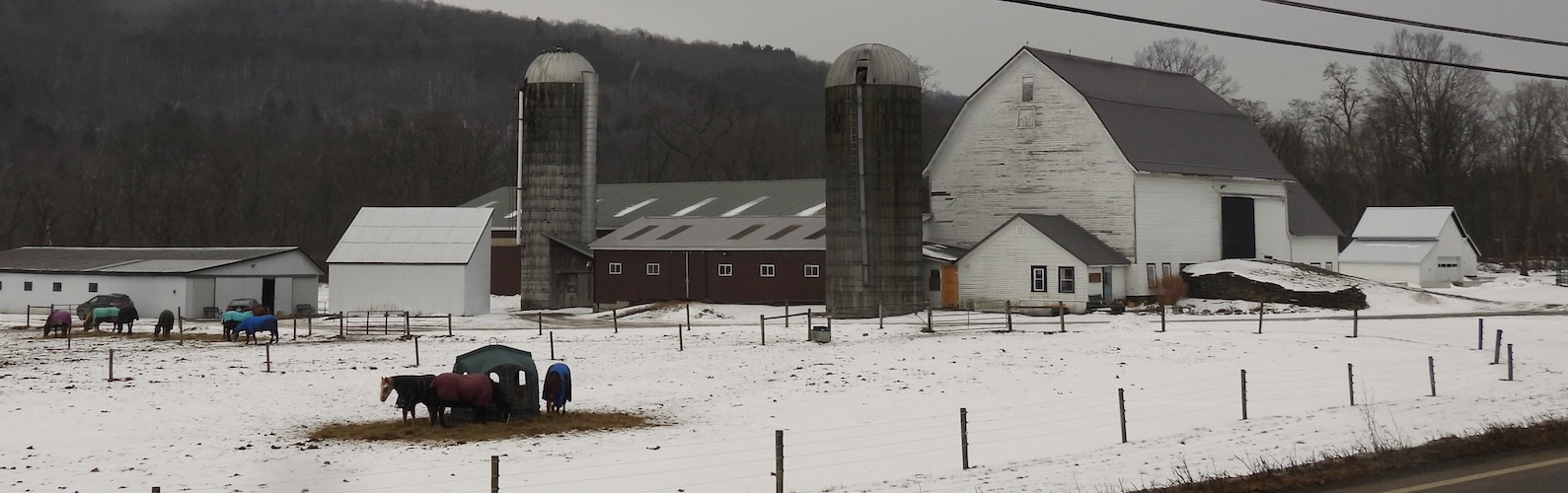
Horses enjoy outdoor time on a warmer winter day at Fargnoli Farms in Apalachin, N.Y. (File Photo / JoAnn R. Walter)
In addition, the state received $382 million in USDA payments from three major programs: the Natural Resource Conservation Service, the Farm Service Agency, and Rural Development. These programs fund a wide variety of projects on and off the farm, including housing, community water systems, renewable energy projects, guaranteed farm loans, conservation reserve programs, and technical assistance for environmental projects. Nearly every county in New York, according to DiNapoli’s report, receives assistance from at least one of the programs.
The report details changes to federal funding for agriculture, including reductions over 10 years of $1.8 billion for conservation and $150 million for forestry programs, and a cut of $84 million in federal fiscal year (FFY) 2026 appropriations for the Farm Service Agency.
DiNapoli cautioned that while some commodities and crop insurance programs will receive increased funding, these changes are likely to have a limited impact in New York.
New York’s dairy sector may be the only local commodity to see a significant benefit since most programs target crops like sugar, wheat, and cotton, which are not widely grown in New York.
The comptroller noted that inflation, coupled with flat funding for other programs, may undermine USDA’s support for farmers and rural communities in New York. He added that the decrease in funding for nutritional assistance programs will mean less money spent at grocery stores, farmers’ markets, and by food banks, resulting in a loss of markets for farms.
Regarding tariffs, the comptroller reported that they affect farmers’ ability to sell products globally and increase the cost of supplies and equipment for farms already operating on thin margins. New York dairy exports declined by as much as 12% in the first half of 2025 compared to 2024. For example, U.S. Soybean sales to China dropped from 985 million bushels in 2024 to 218 million in the first eight months of 2025.
DiNapoli’s report found that prices have climbed for imported fertilizers, steel, and farm equipment.
In July, the National Corn Growers Association found that fertilizer prices had increased from the beginning of the year by between 4.7% and 37.6%, depending on the type of fertilizer.
“Increased uncertainty around markets and production costs makes it tougher for farmers to plan for future growing seasons,” DiNapoli summarized.
Another current challenge facing the farming industry is the enforcement of immigration laws regarding undocumented workers.
New York farms employed more than 56,000 people in 2022, excluding contract farm laborers, according to the USDA. Many of the workers are immigrants who plant and pick crops and work with farm animals.
In 2023, nearly 10,000 were employed through the seasonal H2A federal guest worker visa program, but New York’s Agriculture Commissioner estimates that as many as half of the farm labor workforce in the state was undocumented in 2018.
Recent immigration enforcement has concerned many farmers, especially those in the dairy industry. Even the U.S. Department of Labor recognizes this as a serious issue for the nation’s food supply, stating there could be significant disruptions to production costs and that it threatens the stability of domestic food production and prices for U.S. consumers.
The report noted that the loss of farm employees at crucial points in the growing season, or at any point in the year for dairy farms, could devastate individual farms.
You can view the full report at https://tinyurl.com/4hxdx4y7.

Be the first to comment on "Federal actions threaten New York’s farms and food production"